This article was also published in Marina World'sThe State of Marinas 2026. Click here to read the online version.
The traditional perception of a marina as a mere docking facility is being replaced by a more complex reality: the marina as a multi-dimensional urban community. Modern waterfront developments increasingly function as an intersection of real estate, maritime infrastructure and social engineering.

To explore these dynamics, I reached out to a range of industry experts currently shaping the future of waterfront developments: Luca Dini Design & Architecture (Italy), Marina Projects (United Kingdom), Marina Management & Consulting (France) and Neiheiser Argyros Architects (United Kingdom). Together, they outline a sector in transition where the boundaries between the landside and the waterside are becoming fully integrated.
The most consequential change we have seen in recent years is that waterfront projects are increasingly at the centre of diverse and often competing interests, no longer governed solely by maritime necessity. As Ryan Neiheiser of Neiheiser Argyros observes, “They sit at the intersection of many strong voices: planning authorities, environmental agencies, local communities, marina operators and developers.” Success in this environment requires a “strategic framework”, according to Luca Dini, where these ambitions can be balanced without compromising the project’s core identity.
Cedric Le Rest of Marina Management & Consulting notes that the strongest influences on waterfront design and development often stem from marina owners and their representatives. Navigating an owner’s desire for economic accelerators, “title-claiming” scale and external political influence requires a delicate touch. Conversely, firms like Luca Dini Design & Architecture and Neiheiser Argyros Architects indicate that their designs are increasingly governed by public and regulatory expectations, specifically regarding enhanced water access, ecological health and climate resilience.
How do these stakeholders harmonise to achieve a common goal? The process requires a shift in roles where consultants must act as “grounded, independent voices” and success is derived from “balancing ambition with realism”, according to Cedric Le Rest. Meanwhile, designers serve as a mediator, “a tool that translates political visions, economic constraints and social expectations into coherent spatial solutions", according to Luca Dini.
Simon Goodhead at Marina Projects stresses that managing these influences is dependent on a strategic framework of relationship-building. “The process starts with recognising who the key stakeholders are on any project, whether they are a client entity, licensing authority or part of the wider professional team such as masterplanners or marine engineers. By engaging proactively with our partners and collaborators, we encourage open communication and mutual understanding that ultimately strengthens the delivery of the project.”
.avif)
Planet
Although sustainability and certain green practices have long been considered in some waterfront developments, these initiatives have shifted in approach from mitigation to integration over the last decade, according to Luca Dini.
Material choices have evolved alongside this shift. For instance, Cedric Le Rest notes that aluminium structures may be favoured for their durability, recyclability and lighter footprint. However, these choices must be balanced against environmental factors and operational performance. Ryan Neiheiser also emphasises the heightened industry focus on low-carbon concrete alternatives, responsibly sourced timber and modular systems that allow for maintenance with minimal environmental disruption.
Beyond the infrastructural skeleton, broader marina ecosystems are now a primary design consideration. “Climate resilience standards and the growing focus on blue carbon have fundamentally shifted our design approach,” comments Luca Dini, adding that coastal ecosystems such as seagrass meadows, wetlands and marine habitats are being woven into waterfront planning. In this sense environmental stewardship can evolve from a matter of compliance to the very heart of a project’s identity.
People
“The demographics of the marina sector are changing,” said Marina Projects. “The traditional profile of the long-term boat owner is being replaced by a younger, more diverse and experience-driven audience.”
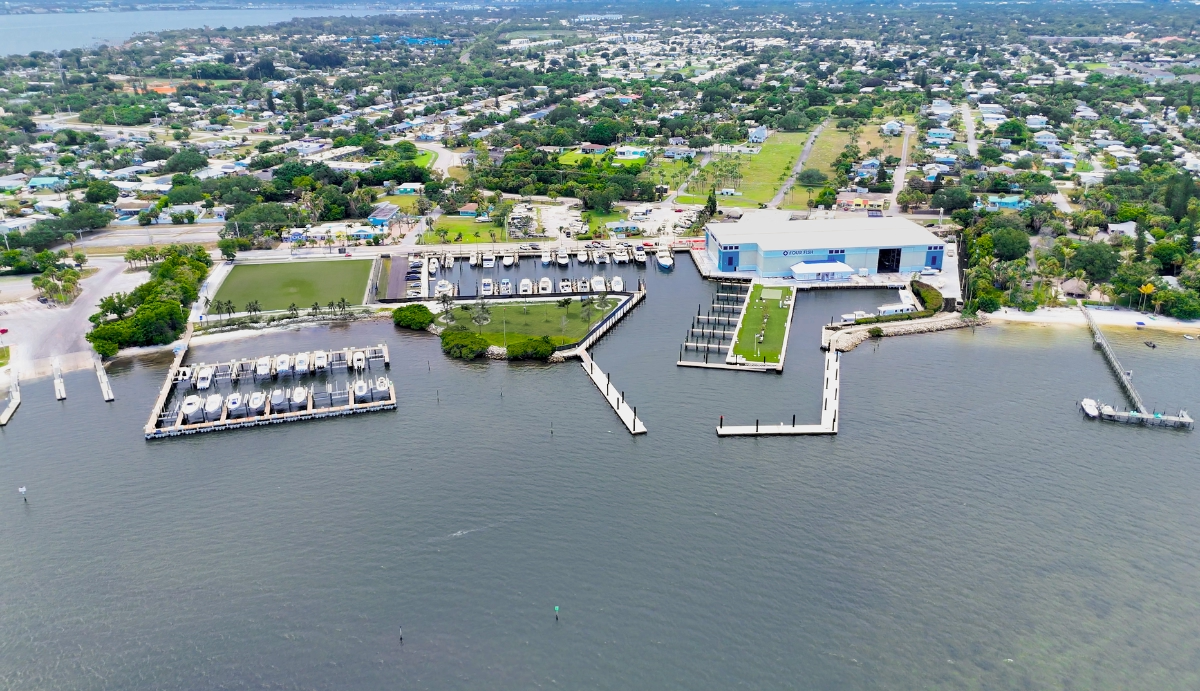
Their managing director, Mike Ward, elaborates: “Many of these new users are cash-rich but time-poor and value convenience over ownership, gravitating towards boat clubs, shared ownership models and charter experiences.” Consequently, facilities must now accommodate higher usage volumes and faster vessel turnarounds through high-density dry stack and full-service launching models.
Furthermore, Luca Dini notes “the growing demand for comfort, connectivity and year-round usability”. Modern marinas must support longer stays and remote-work lifestyles, integrating high-quality wellness facilities, co-working spaces and robust digital infrastructure to remain competitive in this new reality.
Physical design is also changing to match vessel trends. The rise of the catamaran and superyacht sectors means that planners are reconfiguring berth designs and fairway widths to accommodate wider beams. For Marina Management & Consulting, this trend has accelerated the need for land-based dry berthing for smaller vessels, especially in the United States, allowing developers to reallocate water space to accommodate these larger, more complex yachts.
.avif)
Pillars
The viability of a project depends on how well it can translate market demands into functional real estate. For today’s planners, success is no longer measured by berthing capacity alone but by a development’s ability to function as a complete ecosystem.
A dominant theme among contributors was the end of the “fenced-off” technical marina and instead the creation of a “destination”. Cedric Le Rest highlights the case study of Yas Marina where Marina Management & Consulting “significantly enhanced the landside design to better connect the waterfront with retail, hospitality and public spaces, ultimately optimising both user experience and revenue-generating assets” to form a mutually beneficial, if not symbiotic, relationship.
Luca Dini reaffirms this but also expands on a common theme of resilience, long term value and identity. “Identity is equally fundamental,” he said. “Today’s developments cannot be generic or disconnected from their context. Whether we are working on a marina, a mixed-use waterfront or a large-scale masterplan, the project must express a clear relationship with its geography, culture and maritime heritage. This is increasingly important for investors and end users alike, as distinctive places retain value far better than anonymous ones.”
Future-proofing
The ultimate challenge for any developer is ensuring that a capital-intensive project remains commercially and physically viable, with a focus on structural adaptability and technological integration. In an industry where the construction cycle is long but technology moves fast, the goal is to build a destination that can evolve without requiring total reconstruction.
Physically speaking, future-proofing has become a byword for climate resilience. Designing for sea-level rise and extreme weather events has become a global baseline using the likes of self-adjusting mooring systems and elevated quayside heights that preserve accessibility without sacrificing the human scale of the waterfront. Beyond the technical requirements of maritime space, designers and architects such as Luca Dini pursue a complementary strategy that reconciles the marina structure with environmental longevity.
“Resilience today means designing with water rather than against it,” he said. “We now work systematically with adaptive strategies such as flexible waterfront edges, elevated or floating structures, and nature-based solutions that enhance coastal protection while improving ecological performance.”
Beyond the physical docks, there is a clear consensus that “smart marinas” will be the new standard to guarantee operational longevity, with Marina Projects emphasising that “smart marina technologies will transform operations, delivering fully integrated digital networks with contactless services spanning payments, bookings, maintenance and access control”.
Furthermore, by building modular utility systems that can adjust to future energy needs such as high-capacity electric charging or hydrogen fuel stations, planners can ensure that these developments remain functional hubs for the next generation of vessels.
“The marinas that thrive over the next decade will be those that anticipate change, embrace innovation, and bridge land and sea in ways that are environmentally responsible, socially engaging and economically robust,” says Luca Dini. A successful waterfront is no longer defined by its marina and capacity to dock boats, but by its resilience as a lifestyle destination for the generations to come.