This article was also published in Marina World'sThe State of Marinas 2026. Click here to read the online version.
Three areas where there have been particularly significant strides in recent years are in the marina industry’s relationship with environmental management and sustainability, the digitalisation of marina management and the automation of boat handling.
.avif)
The leisure marine industry as a whole takes sustainability extremely seriously. After all, the ocean is essential for our jobs as well as our recreational enjoyment. However, for many years, sustainability messaging has often been aspirational with commitments from operators on company websites or eco-claims made about products often being tenuous.
With the introduction of new clean marina assessments and accreditations, which enable operators to highlight the actions that they have taken to protect the environment, there has been a definite change in attitudes to what “eco” truly means.
We are now entering an era of fact-based sustainability with many countries beginning to legislate on greenwashing, requiring evidence from manufacturers and imposing sanctions where claims are shown to be false. One such framework is the European Union’s green claims directive, which is expected to enter into force around 2027–2028 after adoption and national implementation.
Waste and pollution management
One area where there has been a significant shift in marina operations is in the management of waste and the prevention of pollution. Many marinas now offer waste transfer systems where black and grey water can be quickly and efficiently pumped out and disposed of in alignment with local law. Used engine oils and hydraulic fluids are also collected and stored in sealed containers before being removed by licensed contractors.
The legislation in place that specifies how waste products and potential pollutants must be managed is called MARPOL. It came into force in the 1970s and has 158 state parties, meaning that the vast majority of the world is signed up to it.
Along with waste water and oil, MARPOL also requires that chemicals discharged into the sea must be certified as non-harmful to the marine environment.
This is something that manufacturers like the UK-based August Race are committed to.
The new Oceans Assured initiative from August Race includes a complete reformulation of all products in their existing range as well as the addition of new operational products. All of these have been produced in accordance with the requirements of MARPOL Annex V, which is the part stating that products discharged during operational cleaning activities must be non-harmful to the marine environment.
Marina and boat yard operators are now relaying this message to contractors and boat owners by adding new sections in berthing contracts and erecting signs saying that compliance with MARPOL and the use of non-HME cleaning products is required on their sites.
The insurance industry has also expressed the need for compliance given that breach of MARPOL is considered an illegal act. Paul Miller, the non-executive director at Tide Insurance said: “Insurers would not cover legal protection or fines where the policyholder is in breach of MARPOL while cleaning in a marina. Marina operators may be viewed as more accountable than boaters if they cannot evidence mitigation steps.”
.avif)
ISO 14001
Marinas are increasingly taking a hands-on approach with how they manage operational impacts on the environment through ISO 14001 certification. This certifies that an organisation has implemented a formal environmental management system.
In order to achieve ISO 14001, operators must demonstrate that they actively manage all environmental risks on their sites and that they have set procedures in place to minimise risk. Another requirement is regular ongoing internal auditing to identify areas that could be improved. Some areas of particular focus are fuel handling, waste management and chemical storage, all of which must be assessed and audited by an accredited certification body.
ISO standards have historically been considered by many as simply “more paperwork”. However, marina operators are increasingly seeing the benefits with many commercial insurance companies offering preferential rates for companies holding ISO 14001 given the reduced environmental liability risk. Sutcliffe Insurance Brokers explain: “ISO certification can reduce insurance premiums… It’s proof to insurance companies that you have assessed risks and taken measures to reduce them.”
This level of environmental responsibility is also something that companies are then able to promote as part of their corporate sustainability policy, which is also something that investors are increasingly looking for.
Matt Jones, managing director of Emmerson Wills ISO consultants, said that ISO 14001 is “more than just a certification, but also a commitment to sustainable growth and responsible business practices”.
“Whether you want to reduce costs, improve efficiency or gain a competitive edge, an ISO 14001-certified environmental management system will set your business apart.”
There have of course been many other improvements in marina sustainability which must be mentioned, although I don’t have the space to discuss them at length in this article. These include the rise in drop-in fuels, installation of solar panels and rainwater recycling, and countless individual unique innovations spearheaded by startups and scaleups.
.avif)
Berth digitalisation
Along with environmental management systems, marinas are now widely installing digital booking systems connected to a central platform where boat owners can search specific destinations for marinas and available berths. A similar kind of system has been in place for many years in the hospitality industry, with online platforms offering the ability to view and reserve hotel rooms around the world at the click of a button.
Many of these new platforms also allow users to book on-site maintenance, manage contracts and fuel sales, as well as directly message marina staff to arrange for provisions to be available upon arrival. Customers can see real-time availability rather than having to rely on making contact via phone or email during office hours. Contacting multiple marinas to find a berth can end up being a protracted exercise if there is no availability at the time of calling.
Many of these new systems also offer downloadable phone apps that alert users of new availability, manage invoicing, generate digital contracts and collect signatures. They also inform users of any specific legislative requirements there might be on site and promote any special offers. This in turn serves to ensure that marinas are better able to fill unused space and ultimately increase revenue from visitors that they would otherwise not have been able to access.
One of the widely adopted platforms, Dockwa, states on their website that they have over 30,000 App Store reviews and currently have a rating of 4.9/5. One of the marinas using the platform is Edgartown Harbor, where Charlie Blair works as harbourmaster.
“It is hard to rank all the advantages that Dockwa gives us, but if forced to choose three, they would be the reliability of the software, customer protection and great personal service that Dockwa has provided the town. The ease of using the platform also ranks high.”
Mike Melillo, CEO of Dockwa, says that the platform “makes it easy for marinas to optimise for occupancy and revenue, and close the books at the end of the month. This helps independent marinas compete with larger, institutional operations.”
Dockwa is just one such solution on the market, but the experience of Edgartown Harbor shows what customers value most in marina management software and berth booking digitalisation.
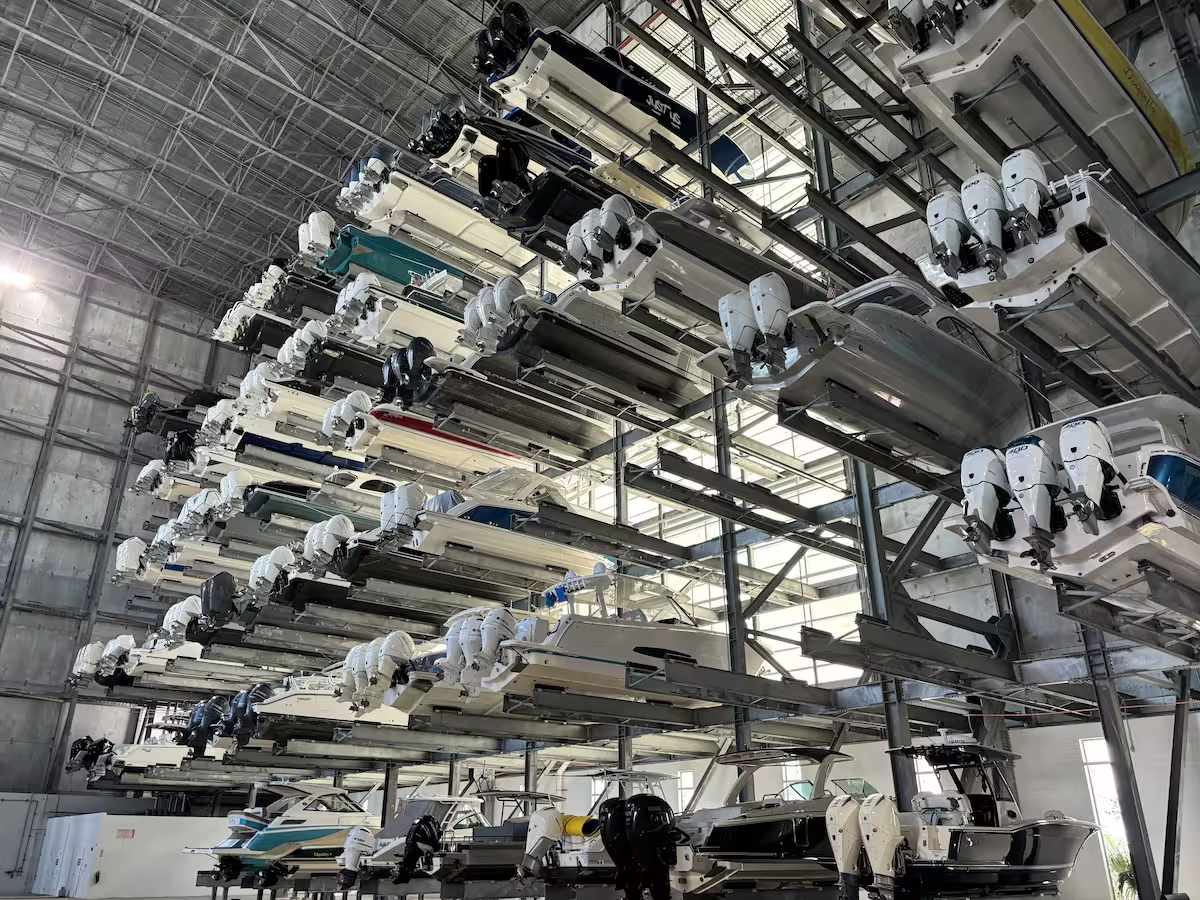
Automated boat lifts offer a significant increase in safety
While automated cranes are not necessarily new per se, their adoption within the marina sector has only emerged in the last 10-15 years. This sort of technology was already being developed in the 1960s as a method to improve storage efficiency and reduce the need for multiple on-site crane operators. Automating boat movements has multiple benefits, with possibly the most significant of all being increased staff safety.
In 2006, a crane operator in the USA was operating a 15-ton travel lift which was being used to remove a 13.4m sailboat from the water. As the travel lift moved forward while carrying the boat, the left front wheel assembly sheared off. The employee was injured when the travel lift fell forward and he was thrown some seven metres from the operator's platform onto a gravel parking lot. He suffered severe head injuries and died later in hospital.Automated marina cranes allow the operators to control the process remotely via a console, meaning they can keep a safe distance from any heavy machinery and thereby dramatically reducing risk exposure. Manual travel lifts often carry large loads across open areas where uneven ground can cause issues with weight distribution, whereas the new automated style cranes lift a vessel using a controlled frame, making it much easier to control balance while operating.
Another area where automation has been adopted with great success is in dry stacks, where forklifts have historically been used to retrieve boats. However, this also presents issues with balance and often means that boats are dropped. The new automated dry stack crane systems operate almost like a vending machine, where a pre-installed crane slides along rails within the dry stack building and then lifts the boat out of the rack before delivering it to site operatives ready for launch.
Marina Vela in Barcelona introduced one of Europe’s first fully automated dry stack systems with a capacity of 222 vessels up to nine meters in length and four tons in weight. The robotised system also provides better service for users as it can be personalised.
Lluís Pascual, head of the automated dry-dock project at Marina Vela, said: “When a client decides to leave their vessel here, the first thing they have to do is an adjustment manoeuvre with the system. This calibrates the machine to adapt it to the characteristics of each boat, including the length, height and width.”
“Such technological advances not only allow us to provide better service for recreational sailors, but also offer a more environmentally sustainable solution as the system offers more berths in less space, as well as minimising the impact on the marine environment,” said Pascual. “In short, after in-depth study, we understood that it is the most sustainable solution, both economically and environmentally, that we could find.”

.avif)