





The inaugural “Nice Boating Tomorrow” boat show and conference, created by Grand Pavois Organisation (GPO), took place in March this year, providing a fitting echo to the site that witnessed the European Ocean Pact announcement at the third United Nations Ocean Conference last summer.
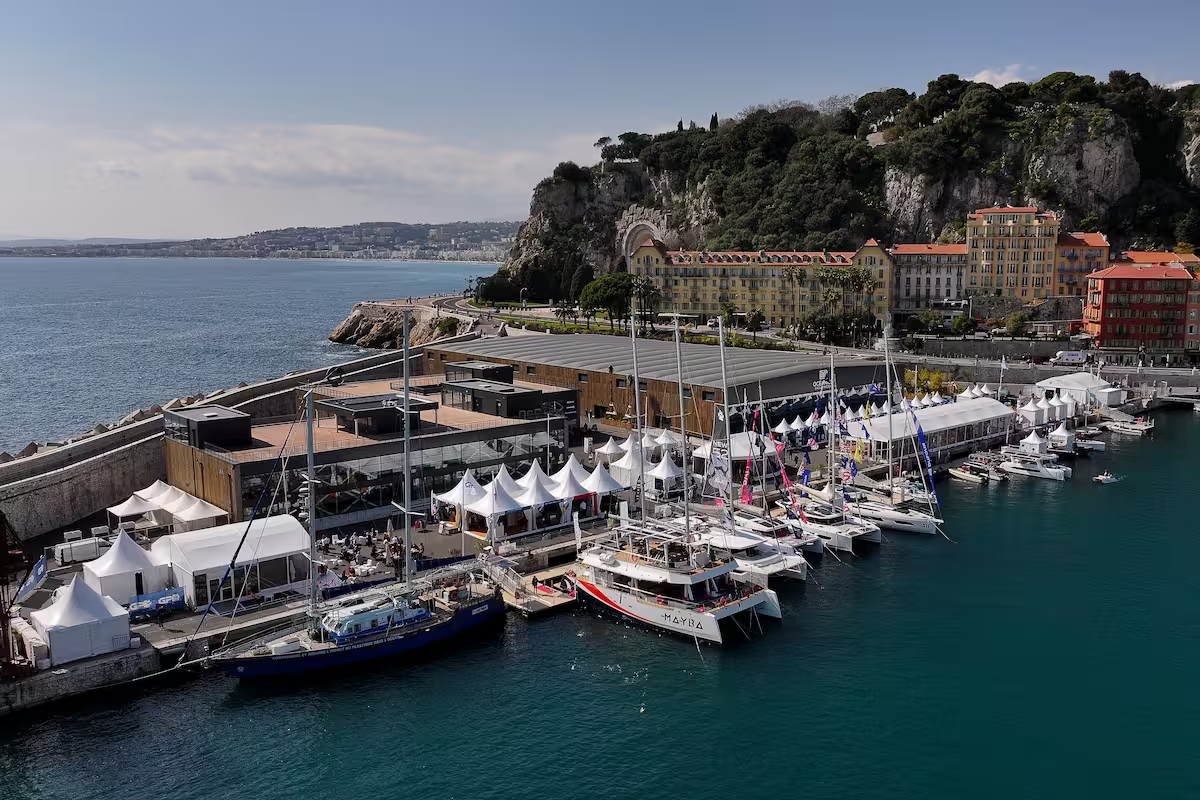
Pitched as "the world’s first international event dedicated exclusively to sustainable boating", the event attracted 80 exhibitors, 40 percent of whom travelled from outside France, to showcase their solutions. A two-day international forum, professionally managed to offer continuous bilingual content to around 150 participants, delved into the practicalities of the energy transition, covering topics such as alternative propulsion systems, eco-design and the modernisation of marina infrastructure.
Insightful content included "Boat-to-Grid" systems from Littoral Energies that transform berthed vessels into shared green energy storage hubs and Yuniboat’s eco-reconditioning of abandoned or neglected boats, providing not only a second life (with a two-year guarantee), but the chance to upgrade to cleaner propulsion systems. Currently providing free transport to their French yard from surrounding countries, they offer marinas the key to clearing their backlog of derelict vessels. Options are limited for now to fibreglass hulls in a decent condition.
Managing pollution
Delegates also received a progress report on the new ISO 18725 standard (Ports Propres), created by Union des Ports de Plaisance Provence-Alpes-Côte d'Azur et Monaco and the Fédération Française de Ports de Plaisance.
This two-stage certification obliges marinas to first identify and mitigate external and internal sources of pollution in the marina, before moving on to active intervention to protect and restore terrestrial and marine life within the port's zone of influence. Each step requires full staff involvement and seeks to educate and engage visitor and resident boaters. Despite being launched only last year, over 80 marinas in France now have full certification, with a further 90 said to be on track.
Solar power
Since the Mediterranean coast poses practical opportunities for solar, various boat clubs discussed their success with entry-level, no-licence-required rental using outboards with less than 6hp. This was proving to be very popular with completely inexperienced users, happy with lower speeds and a reduced range, with the lack of fuel costs a benefit for all parties. Some clubs manifested concern, however, that commercial expansion was being constrained by grid limits in marinas, putting pressure on operators to secure the extra electrical capacity needed to ride out the high-season surge.
On the docks, the attractive display was both silent and impressive, where jet-skis, a notably divisive boating segment, were represented by an off-piste looking electric model from Finnish company, Viva Electric Jets. The standard battery offers 2 hours of use at a sustained speed of 20 knots, and a 30-minute fast charge will provide up to 80 percent battery capacity, posing an interesting option for marina-based commercial fleets.
Hydrogen refuelling
Dhamma Blue, developer of Spain’s first hydrogen-powered recreational dayboat, was also present. The DHB-P01 combines electric propulsion with a hydrogen fuel cell to deliver a top speed of 28 knots and a cruising range of 65nm at 12 knots.
After years of preparation, the final permits are being secured to install a temporary green hydrogen refuelling system in Mallorca during the month of July. Designed to refuel the DHB-P01, Dhamma Blue will soon invite stakeholders and visitors to experience first-hand how a complete hydrogen ecosystem works in practice, demonstrating the viability of this technology for deployment in marinas.
Intelligent, clean, experiential, social
Victor Meyer of M3/Monaco conveyed the pressures of rapid technological evolution and mounting environmental expectations via his "ICES" framework for marinas: intelligent, clean, experiential and social. Bringing people squarely to the fore, he declared that “the marina of the future isn't waiting to be invented, it is waiting to be decided”. As he sees it, the real transformation relies on the harbourmasters, local communities and boaters themselves driving the change today, rather than pushing it down the road for the next generation to solve.
This sentiment was shared by GPO’s communication, marketing and strategy manager, Pierrick Garenne, who highlighted the necessity of the Nice Boating Tomorrow event:
"We have been organising boat shows for over 50 years, notably with the Grand Pavois in La Rochelle. By being in constant contact with professionals, we realised that something significant is happening regarding sustainable yachting and eco-responsibility. Our goal was to challenge the idea that we can simply wait and see. If we remain on this track, it will soon be too late. We have to move, we have to progress and we are here to show that sustainable boating is making real progress."


