This article was also published in issue 152 of Marina World magazine. Click here to read the online version.
In coastal development projects, we need to understand storm hazards such as flooding and wave impacts and recognise that they are only getting worse due to sea level rise and other effects of climate change.
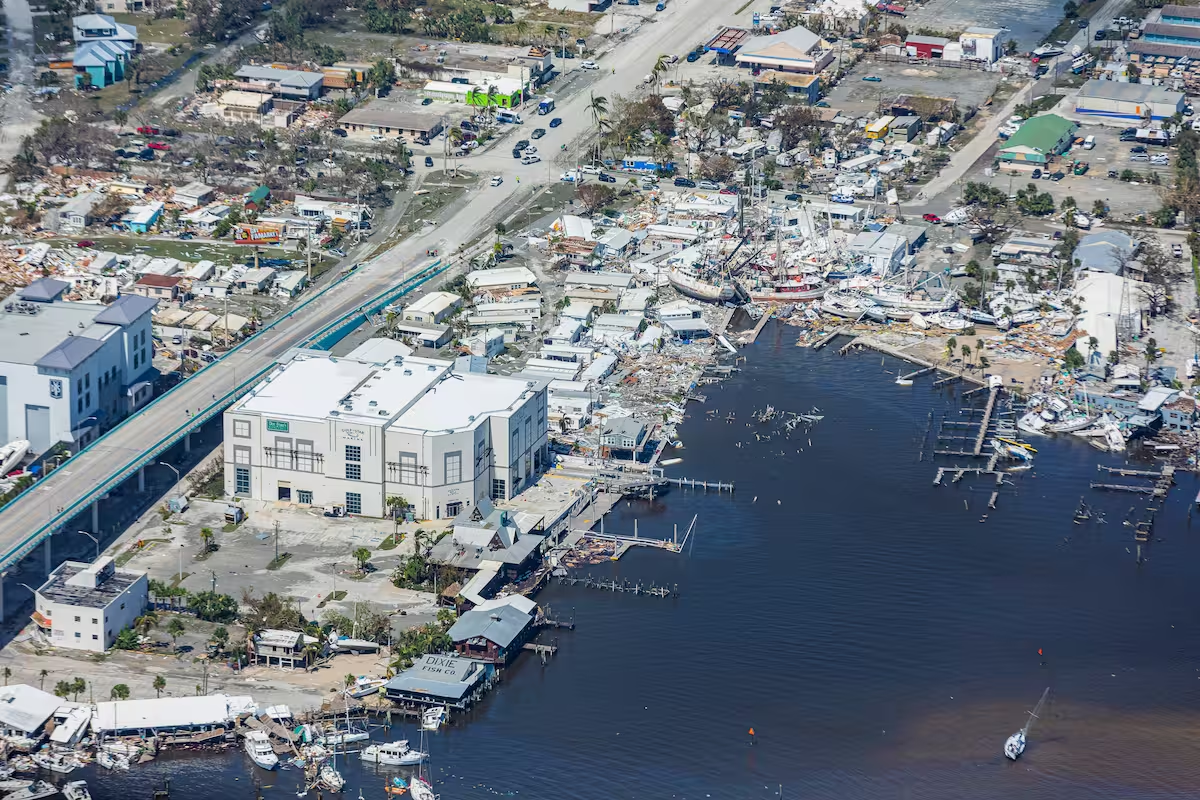
Marinas are a unique real estate business asset. Despite the large variety in market drivers, infrastructure requirements, size, project elements and business models, we know that they are all intrinsically exposed to extreme weather events due to their location at the water’s edge.
Over the last decade, the real estate industry went from having the comfort of insurance addressing all potential physical risks, to being impacted by unexpected premium cost increases and loss of coverage. Despite understanding the market risks of an investment, we are starting to see reduced property valuations due to physical risks. In fact, investors are already shifting from completely ignoring climate change’s physical impacts to taking their financial impacts very seriously.
Insurance is not as predictable as it used to be
The cost and availability of insurance is a new type of uncertainty for real estate investments. Insurance industry factors beyond the control of real estate developers and investors are driving these changes, but the full extent of the consequences for the real estate and marina industries are only starting to emerge.
Paraphrasing a Caribbean investment banker: “A recent review of a loan awarded by our bank a few years ago showed that while all operational expenditure line items were predicted with extraordinary precision, the insurance costs were grossly underestimated to the point of jeopardising the financial performance of the whole investment.”
And a leading marina asset manager said: “We have been successfully negotiating insurance conditions for our marina portfolio primarily based on the distribution of uncorrelated risks among our assets; however we have not yet achieved full recognition of the improved resilience characteristics of individual assets in the discussion.”
For many years, one challenge I faced as a designer was that additional resilient features included in projects were not rewarded by insurance. A fundamental systemic problem was that two facilities with different resilience performance in the same coastal location were treated similarly.
But some changes are starting to emerge. Some real estate asset managers have been able to negotiate reductions to premium increases based on resilience features. For the first time, some insurers are publicly saying that they will consider the risk reductions achieved by improved design features and even offer to be involved in the design process.
For underwriting and marina financial modelling, the conclusion is that insurance cost contributes significant uncertainty within the investment period. The conventional approach of relying only on insurance to address all physical risks - and at a predictable cost over the holding period - is no longer valid. More technical understanding is required to inform physical risk evaluations, including cost of physical damage and operational disruptions, to manage financial risks.

Valuation will eventually include climate risks
Another financial implication of coastal risks and the increased hazards due to climate change is on valuation. Financial models rely on both an acquisition and exit value, and in this regard I am most concerned about projects that have been modelled with exit values that are not adjusted for physical climate risks.
My personal “$10-million story” is the reduction in transaction price achieved by a sophisticated investment fund that used technical due diligence services that I directed a few years ago. Offer condition statements brilliantly crafted by the attorneys, combined with an efficient marina market and coastal engineering review of facilities and plans, had an outstanding outcome for the buyer. In summary, our technical due diligence “adjusted the market price” by $10 million USD to reflect coastal risks.
The marina industry already has multiple investors worldwide that have been building marina portfolios. Have they considered future increased risks and climate adaptation needs? Although other upside opportunities might have pushed this issue to a secondary role at the acquisition stage, they should be part of the portfolio risk management.
A necessary question is how to assess the climate risk-adjusted exit value in a financial model. As I once suggested to a beachfront hotel portfolio owner: “We need to think about what the technical due diligence of the buyer is going to determine when you are exiting the investment.”
We can’t predict what kind of information and risk evaluation tools will be available in the future, of course, and my question to the hotel owner was rhetorical. I could only advise on the fundamental concepts and the drivers that will determine future climate risk-adjusted valuations.
Marina valuations will eventually include climate physical risks, either as discounts or premiums. Technical due diligence is the tool to expose the relevant information for accurate valuations.
Asset financial management implications
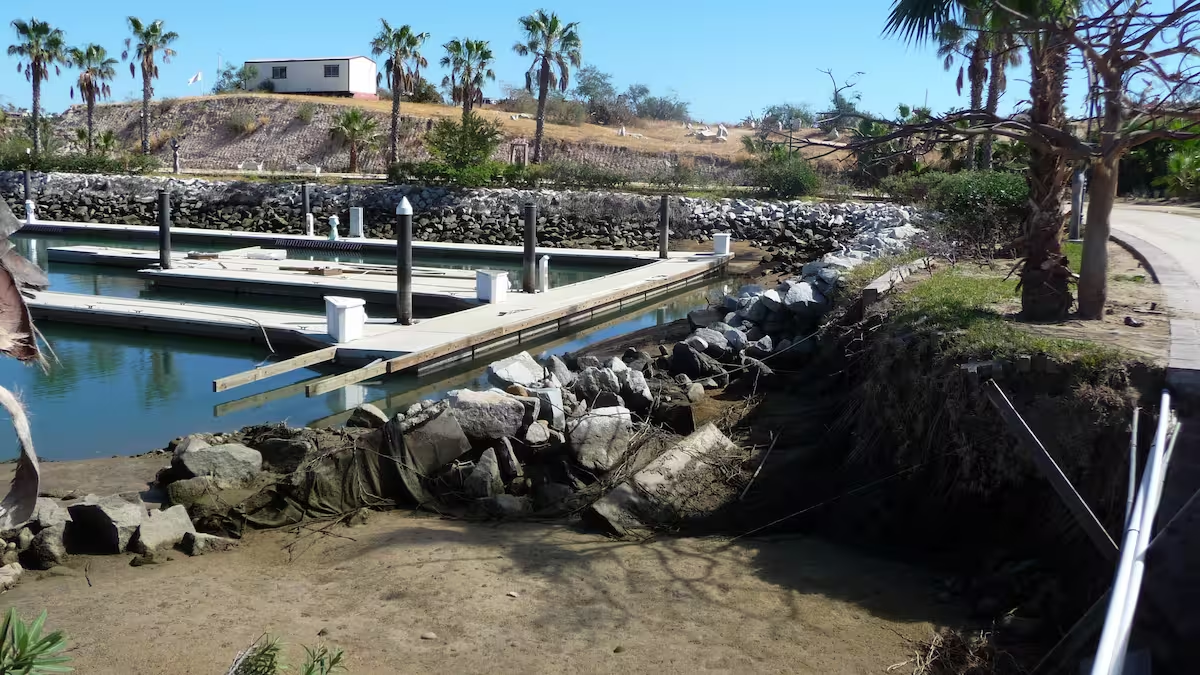
It is critically important to understand both the coastal physical risk profile of individual marinas and that hazards will only get worse in the future. Therefore, resilience investments are required to avoid significant future risks.
Large-scale, multi-hazard climate risk analysis platforms are often presented as the ultimate solution for real estate investors. I am starting to use TWINN by Haskoning data, but technical interpretation is still needed to assess risks at an asset level, especially for marinas.
The “good news” is that understanding the risk profile at an asset level and defining an appropriate climate adaptation strategy has positive financial impacts. “When climate risks are managed with the right tools, insights, strategies and partnerships, they can unlock powerful opportunities for innovation, resilience, and sustainable growth” says Alexandria Norris-Moore, Climate Change and Resilience Advisory Regional Lead at Haskoning.
Some lessons learned
I have been working on this issue for a few years now. I started by developing engineering tools to quantify short- and long-term coastal hazards to improve design of coastal real estate projects. Along the way, I have used the same criteria as part of technical due diligence. More recently I have begun to analyse how to improve conventional financial modelling tools that do not explicitly address climate risks. Now, as part of the Haskoning marina team, I am working with a large network of in-house experts in many contributing fields, with a vast toolbox of technical resources.
One important lesson is that this is not about regulations, but investment fundamentals. Specifically, this is not a compliance issue, as it requires thinking beyond present regulatory requirements. Yes, there will be regulatory and compliance implications, but the justification for this analysis can be made in financial terms only. And the deeper that private investors embrace resilience, the better they will be prepared to address regulatory challenges.
The marina property coastal resilience assessment is an analytical process, which can be implemented at various depths. If it is too superficial (like only using data analytics platforms), it may not provide adequate information; but if it is too detailed, it may become unnecessarily expensive. The key is understanding the technical, market and financial drivers to assess investments, and using the right depth of analysis to generate information for decision-making.
Embedding climate adaptation in marina design is a new design art form that is only in its infancy. Among other implications, we cannot establish a “design life” if we do not think about “the day after”. As always, climate resilience solutions cannot be applied haphazardly and need to emerge from the project needs.
.avif)
Depending on the time horizon of the analysis, some assets may have an “expiration date” or a future scenario under which the adaptation costs become unaffordable. Stranded assets have already been identified in some portfolio evaluations by sophisticated investors, resulting in null exit values. In some cases, they may also risk having future climate liabilities. This may feel too far-fetched today, but it should be part of the financial analysis context.
Among the climate adaptation strategy details, I embrace the concept of “bouncing forward” or building back better. It is critical to have a property climate adaptation plan so that any investment in disaster recovery works is done for future, more demanding, conditions. “It is hard to stop and think during the recovery stage,” so disaster recovery plans should be outlined in advance.
I like to stress that “every new investment must consider resilience to increased hazards”. There is nothing worse than spending money in market-driven redevelopment that ends up increasing risks unnecessarily.
These issues are exciting for marina and waterfront design professionals, but they emerge from the same fundamentals. As I like to say regarding marina design process, “the approach is always the same, the outcome should always be different”.

.avif)