This article was also published in issue 152 of Marina World magazine. Click here to read the online version.
Several new marinas are being built on the Black Sea, though industry development remains sluggish due to a mix of environmental and economic constraints, and above all, security fears associated with the ongoing war between Russia and Ukraine.
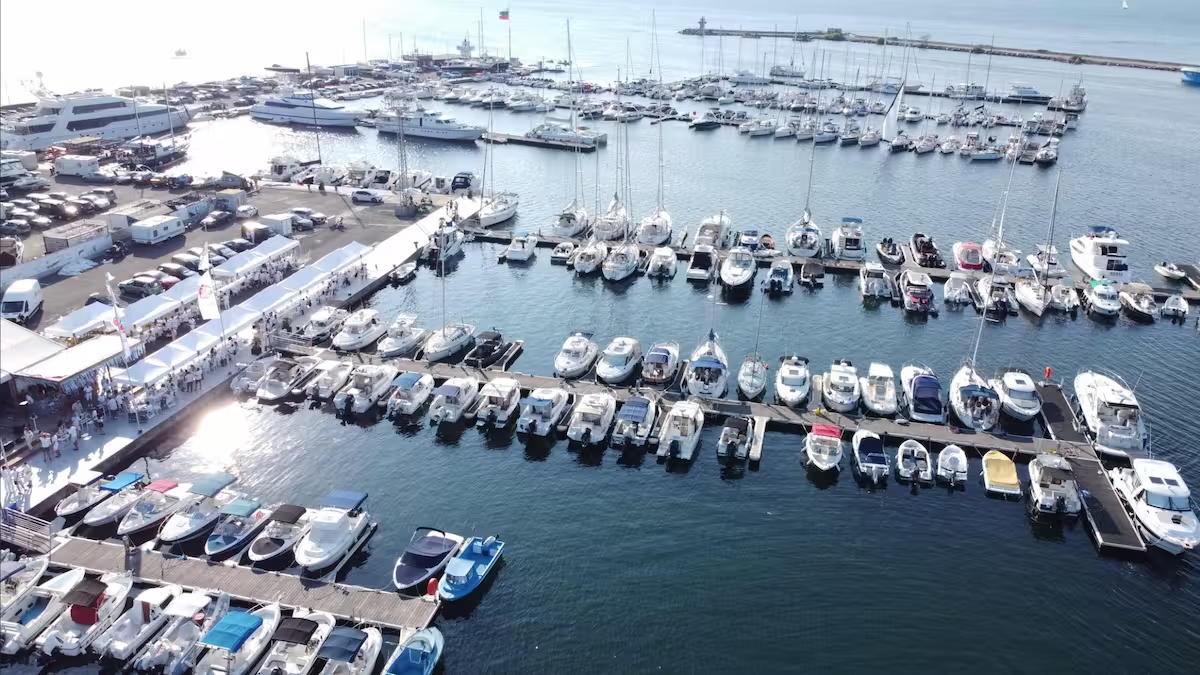
Several new marinas have been put into operation along the Bulgarian coast over the last few years, according to Dimitar Panayotov, CEO of a yacht marina in Port Varna and a member of the board of the Bulgarian Boating Industry Association.
"There are a few new small marina projects that have recently been finished in the south, which are already proving to be much needed as all the berths are occupied," Panayotov said. "There was also a relatively big one finished not so long ago in Burgas – the major city in the south."
New marinas bridged the gap between supply and demand, which emerged due to a slow but steady rise in the popularity of yachting in this part of Europe.
"Even though yachting is a relatively new activity in Bulgaria, for most people who give it a try it becomes a regular part of their recreational activities," Panayotov added. "Boat ownership is not something many people can afford or have the time for, but yacht charters are one of the most favourite ways for the Bulgarians to spend their summer vacation."
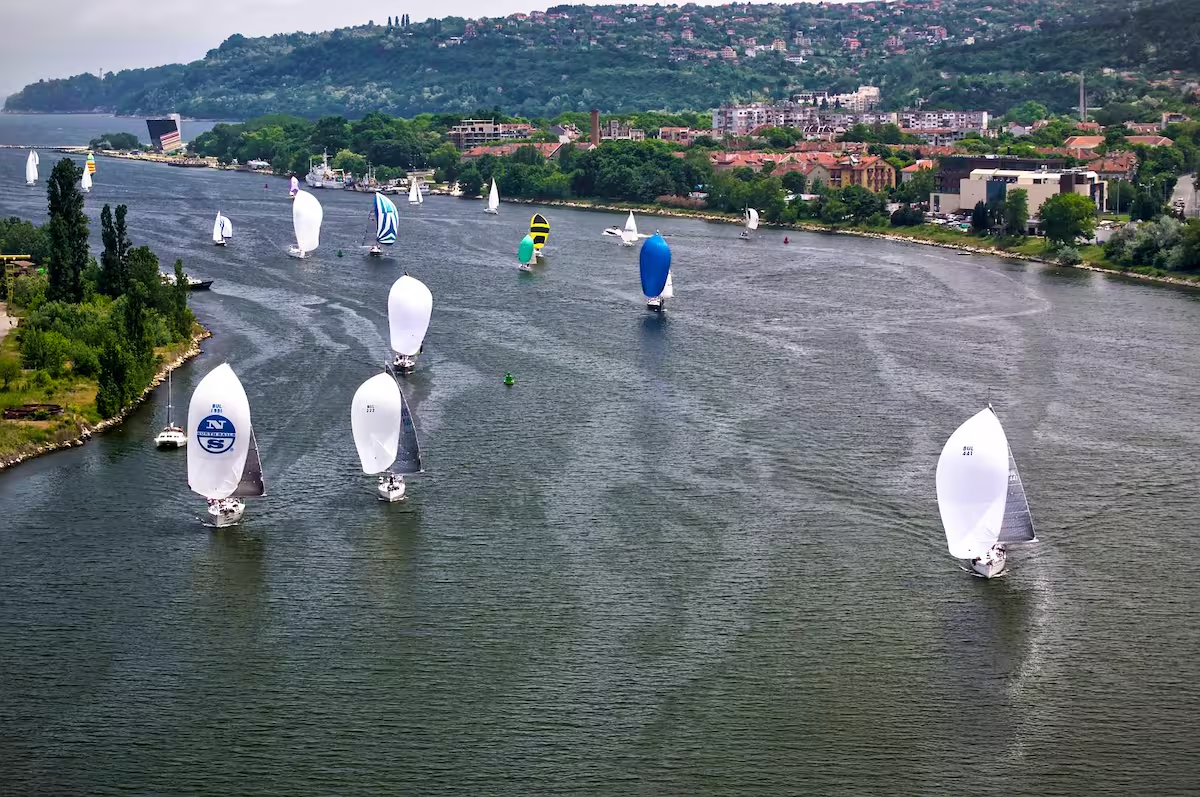
The marina industry in Bulgaria has received an additional impetus for growth thanks to the rising number of sailing events. According to Panayotov, Bulgaria regularly hosts at least 10 events per year, with a minimum of 30 boats each. One of these events, the Varna Channel Cup, is one of only two places in Europe where a channel is closed for navigation for a racing event. The other is the Bosphorus Cup in Istanbul.
Romania’s Maritime Spatial Plan
In Romania, the yachting and marina industries are slowly growing, commented Radu Niculăiță, President of the Romanian Yachting Federation. One of the primary constraints is that Romania has a relatively short coastline of around 245km, Niculăiță said. Currently, the industry comprises four large marinas: Mangalia Tourist Port, LifeHarbour Limanu, Eforie Nord and Portul Turistic Tomis in the port of Constanta.
Despite the constantly growing fleet of motorboats and sailboats in Romania, the marina industry lacked development in recent years, primarily owing to existing marinas' restricted capacity to expand their piers, Niculăiță said.
"Until recently, there was no clear plan to develop the charter boating business on the Black Sea coast, but now authorities have spotted the opportunities offered by boating tourism and put together a few developing plans for building new marinas," Niculăiță revealed.
In 2023, following years of preparation work, the Romanian government hammered out the Maritime Spatial Plan – the document that market players believe will be the key to the marina industry development in the coming years. This strategic planning document establishes a framework for the integrated, long-term management of Romanian Black Sea waters, encompassing activities in the field of energy, shipping and tourism. Several new marinas are planned to be built under this document, partly with the use of EU funds.
Romania's Maritime Spatial Planning includes projects such as Marina Diamant and Marina Nord in Constanta, as well as expansions and modernisations at Eforie Nord and at a couple of smaller marinas.
According to Niculăiță, the Mangalia Tourist Port is a key precedent, laying the foundation for similar projects in the industry. Rebuilt with approximately €4.07 million in EU funds between 2006 and 2008, the project was a notable success as visiting-boat traffic rose steadily from 2014 to 2019, confirming unmet demand.
Growth in the east
Several significant projects are in the pipeline in the eastern part of the Black Sea, namely in Turkey and Georgia. In July 2025, local authorities revealed that the construction of Turkey's first and only yacht marina in the city of Sinop had begun. The Sinop governor's office stated that the marina will contribute to the economic, social and environmental development of the region, with the project expected to boost regional tourism and resolve long-standing land-use tensions between fishermen and yacht owners. The governor’s office has also stated that they hope to attract more national and international yachters.
Although Turkey has a well-developed marina industry on its Aegean and Mediterranean shores, the Black Sea coast has long been neglected by investors. There are two major factors that can cause the underdevelopment of yachting and the marina industry in Black Sea region, commented Onur Ozgey, Managing Director of 360 Yachting, a Fethiye-based yacht-renting firm.
"The primary reason would be the weather and the conditions of the sea. It is not as warm as the other parts of Turkey, with frequent rains, strong winds and a rough sea. The nature and geography are beautiful in their own way with green forests and mountains everywhere, but the area doesn't have as many bays as the Aegean or the Mediterranean," Ozgey explained. He added that another major factor is that it is less accessible compared to other yachting areas.
"It is easy for countries located on the Black Sea, but all the others must pass through the Dardanelles, the Marmara Sea and the Bosphorus to be able to reach the Black Sea, making it a significantly long and expensive round-trip journey," Ozgey added.
According to Ozgey, the first yacht marina in the Black Sea region is undoubtedly a good project for the area's yachting development. However, due to natural constraints, it may not have a significant impact on the popularity of yachting in the Turkish Black Sea.
"For sure, it will be a good development locally, for Turkey's Black Sea region as well as the surrounding countries such as Georgia, Russia and Bulgaria. However, considering the global aspect of yachting, which is mostly associated with blue calm waters, sun and sand, the Black Sea may not be a good match due to the harsh weather conditions," Ozgey said. He argued that the effects of global warming and changing weather conditions may make the area a more attractive international yachting hub.
A stone’s throw across the border into neighbouring Georgia is another recently-announced marina and waterfront megaproject. A 260-hectare megaproject in Gonio, south of the seaside resort city of Batumi, is set to include hotels, residences, leisure facilities, luxury shopping and “the largest yacht club in the region” with a modern yacht marina. The Gonio marina project and another waterfront development in Tbilisi are being funded by a $6.6 billion USD investment from the Emirati developers Eagle Hills and EMAAR Group. The former is being built completely from scratch and has a planned delivery date of December 2029.
The Crimean question
The elephant in the room when it comes to any discussion of boating in the Black Sea is Crimea, internationally recognised Ukrainian territory that Russia illegally annexed in 2014 and has occupied ever since.
Despite Russian authorities being keen to portray Crimea as an attractive boating and tourist destination with the construction of several new marinas, the politically charged and militarily strategic peninsula is frequently the target of Ukrainian strikes, with videos emerging online of Russian holidaymakers fleeing in panic from beaches to the soundtrack of explosions. What’s more, any vessels brave enough to dock in Crimean marinas in the future would be illegally entering internationally recognised Ukrainian territory and would make themselves vulnerable to repercussions from the Ukrainian government in Kyiv.
A source in the Russian yachting industry who wished not to be named commented: "Economic feasibility behind new marina construction in Crimea remains questionable. Unless some tectonic political shifts happen, there will be no foreign yachtsmen in the foreseeable future and relying solely on local payment demand the investments pumped into these projects will never pay off."
.avif)
War to the north
In previous years, the western part of the Black Sea used to have boats coming from Ukraine and Russia, sometimes even participating in joint Romanian and Bulgarian sailing sport events. However, this is no longer happening, Niculăiță added. Security issues have also directly restricted yachting activity in certain areas.
"The Black Sea security situation somewhat restricted activities on the Black Sea Coast," Niculăiță admitted. "We are more careful regarding mines that might be floating close to the shores and we avoid long offshore sailing up north to Sulina near the Ukrainian border due to the risk of mines and drones," Niculăiță added.
In Bulgaria, which does not share a border with Ukraine, fears related to the Russia-Ukraine war remain moderate.
"Of course, there is chatter about and substantial proximity to what is happening in Ukraine, but we have not seen anything concerning in our part of the Black Sea apart from a few old mines last year. So yachting activities are going as usual," Panayotov said.
The Russia-Ukraine war is however being closely followed on the Turkish side of the Black Sea, likely affecting investors mulling plans to build new marinas.
"Instability in the region will always affect yachting. Yachting is very sensitive," Ozgey said.
In Ukraine, all yachting activities are put on hold as the State Border Service of Ukraine imposed a ban on the movement of all vessels, including yachts, in the Black Sea, as well as on the Dnieper River and other bodies of water in the country, except in emergency cases and with special permits. The ban will remain in force as long as martial law is in place.
The end of the full-scale invasion, which is now continuing for the fourth year with no end in sight, is believed to be the key factor that will allow the Black Sea marina industry to truly unlock its potential.

.avif)