This article was also published in issue 152 of Marina World magazine. Click here to read the online version.
"Since becoming editor of Marina World many have told me that the marina industry needs modernising with fresh ideas and approaches. It is true to say that the marina industry moves slowly, but this should not be an excuse to become too comfortable in the mindset of 'if it ain't broke, don't fix it'. It is a choice between accepting what is good - or working to make it better.” Patrick Norén, editor of Marina World.
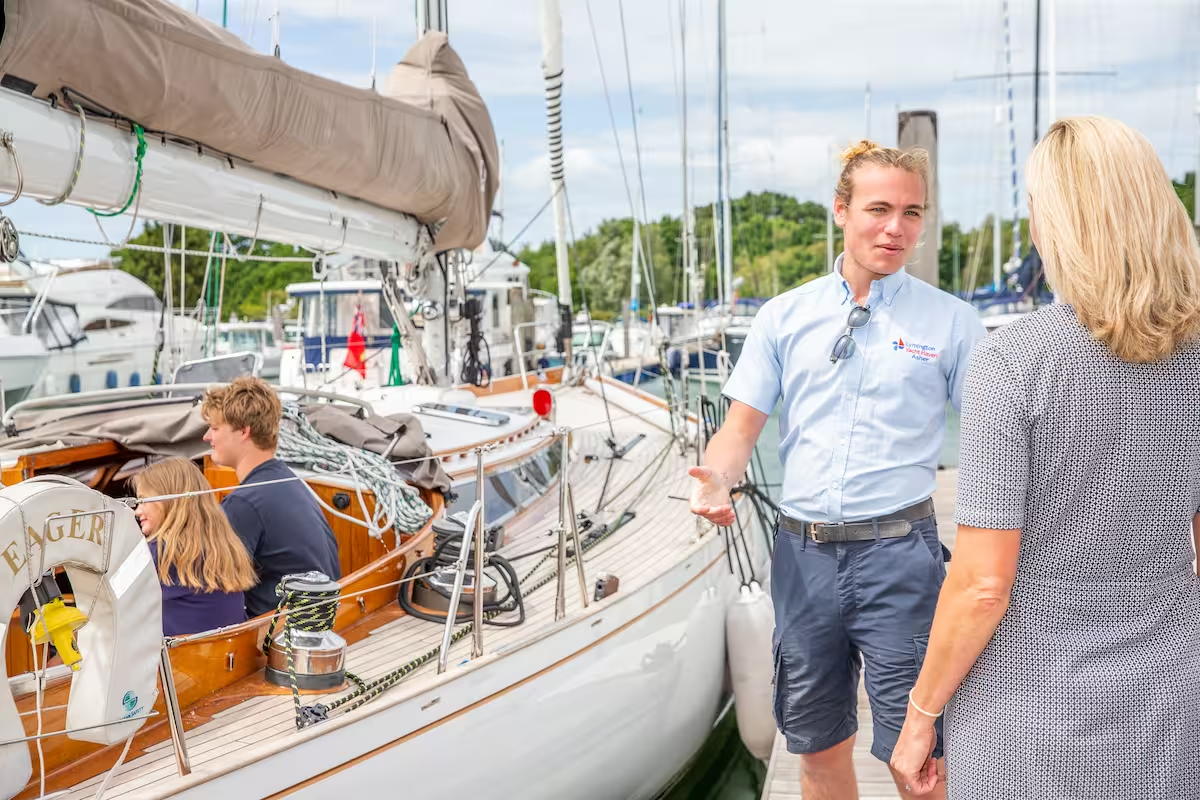
For years, many marinas succeeded simply by offering a safe place to park a boat. But today, the industry is operating in an experience economy where customers value memories and meaningful moments over simple transactions.
This shift comes with combined pressures we can't ignore: an ageing customer base, affordability and the need to connect with new generations who prioritise flexible access over long-term ownership, communicate on different platforms and demand transparency, environmental accountability, and a genuine commitment to community and purpose. Moreover, many agree that the industry has a worrying tendency to talk to itself instead of reaching out and actively listening to the needs of non-boaters and wider stakeholders.
In the following pages, media professionals, company founders and experts from the industry and academia generously share their advice and perspectives on how marina teams can up their marketing game.
Data-driven experiences
Debbie Parsons-Randle spent nearly two decades in the hotel business before her swift ascent at IGY Marinas to become vice president of global marketing. She recognises that, comparatively, marinas represent “a much more niche market and set of very individual customer requirements” but admits that “hotels are streets ahead via their use of tech, data, platforms, etc.” She notes that “the marinas that adopt some of these tools, such as CRMs or engaging in customer segmentation, will definitely gain a cutting edge.”
Dr. Riccardo Spinelli, associate professor in management at the University of Genoa's Department of Economics, spoke at the recent ICOMIA World Marinas Conference in Venice.
“To deliver services that truly reflect individual preferences, it is essential to understand customers’ behaviour and the expectations shaped by their marina and boating experiences.” In this way resources can be put to better use to both drive loyalty and potentially generate higher financial rewards for the marina. He understands that marinas might be host to many different business models.
“Groups of boaters that welcome the social side and enjoy being seen - the ‘conspicuous consumption’ type - may welcome being located visibly in the marina and receiving VIP packages in line with their philosophy. For others, the priority might be boating and being on the water. They may not enjoy the noisy, social aspect of a marina and prefer a quiet berth away from the crowds.”
“Marketing”, Dr. Spinelli describes, “is about helping the customer achieve their perfect outcome. The core idea is simple: value is not in the thing you buy; it's in how you use it. Instead of just advertising a berth, marketing needs to focus on helping the customer realise their goal, whether that's relaxation, connecting with family or having an adventure. The marina's job shifts from being a salesperson to being a partner - or facilitator - that makes sure everything is perfectly arranged for the customer to have that ideal, complete experience.”
Value co-creation
Yachting media figure, Mark Jardine, reflects that marketing is all about education and facilitating access to boating. He recommends “building content from authentic case studies, so that the potential customer finds it relatable and thinks: ‘That’s me. That's how I can get out on the water.’”
Established industry player Navily operates a marina reservation platform that aims to inspire boaters to try new destinations. Co-founder Edouard Fiess describes his early days in boating and frustration with the paucity of available information about marinas, where current wisdom travelled through small circles of influence - discussed on the pontoon, debated at the bar and shared directly between neighbouring boats.
“When I asked about a destination, I was given a huge scholarly tome with the advice:
‘Read this, you’ll see it’s beautiful.’
‘But there are no pictures…’ I’d counter.
‘But read the description’, they’d insist, ‘You’ll see that it says that it’s beautiful.’
Trying to make a reservation with outdated information was yet another challenge.”
Discussions with marina operators around the company’s inception in 2014, elicited an almost blanket rejection of a reservation service and an absolute horror at the idea of reviews. Today their platform features 1000 partner marinas across 20 countries, lists 130,000 reviews, and serves over 400,000 active boaters.
Platforms like Navily have recognised that achieving scale and market accessibility works best with co-creation - akin to models like TripAdvisor. This shift transforms the customer from a passive consumer into an active partner whose contributions - and not just their purchases - drive the platform’s competitive advantage. “Before you might have the word of one pilot guide author; now you have 50-100 people sharing their opinions and bolstering the available user-based information about the marina.”
“Marinas used to refer to bookings by the name of the boat. After receiving advice, we made the owner more prominent (photo, first name and last name) humanising the profile. Marinas now welcome a person. One of the truly gratifying developments we’ve seen is marina manager job descriptions explicitly calling for ‘Navily / online booking platform experience’. The new goal is clear: proactive management of customer reviews, feedback and the end-to-end customer experience. Some marina employees tell us that they are even financially incentivised for good reviews, creating more accountability in customer service.”
AI: tool or trap?
Artificial intelligence of course plays an inevitable role and its growing significance as a curator of online search results cannot be ignored. In a fragmented media landscape, the challenge for marinas is not just where to post, but how to build trust in a measurable way.
As Mark Jardine describes: “AI can create churn media, but it is thankfully also very good at filtering out this junk. Consequently, there’s a need to create media that is truly engaging, otherwise AI will simply ignore it.”
Marketing professional Rebecca Whitlocke, founder of Antibes Yachting, describes the importance for marinas in building a sustainable and authoritative brand in the age of AI, one that consistently spans both their real and online presence:
“Within an AI-controlled information ecosystem, where large language models such as ChatGPT and Gemini can produce vast amounts of generic, fairly well-written content, your authority is no longer solely based on what you say, but on who you are and the proof you can provide. This shifts the focus from simply generating content to demonstrating verifiable facts, trustworthiness and providing unique insights. Achieving this legitimacy also means being backed up by referrals from other respected industry members, demonstrating industry certifications and counting on quality backlinks. Essentially: does your online footprint back up your claims?”
Again, getting the messaging right for each segment is essential: “Marinas will also need to ensure that they can demonstrate upholding values held by younger generations,” advises Whitlocke. “These include having a clearly defined purpose and generating social impact through local partnerships, such as supporting environmental stewardship or charitable causes.”
To further solidify their authority, she stresses the need to be transparent and proactive regarding wider industry issues. By engaging openly on economic and regulatory impacts, such as local and national maritime regulations and supply chain factors, marinas demonstrate their commitment to promoting the greater boating community and economic health, which solidifies their trustworthiness.
Both Whitlocke and Parsons-Randle point out that beyond the benefits of generative AI, marinas should consider the associated risks, where staff training is beneficial to safeguard data security and confidentiality, flag up areas of potential liability and encourage critically evaluating AI’s outputs.
Defining your USP
A marina’s unique selling point, then, central to their brand, can be the one thing that avoids sounding generic. As Jonathan Cook, group marketing manager at Yacht Havens Group, describes: “Although Yacht Havens is a group of nine marinas across the UK and the Netherlands, our USPs have always been defined at local level. Each Yacht Haven operates as its own destination, shaped around the needs, habits and expectations of its local boating community.
We predominantly market our marinas on a site-by-site level, building marketing strategies that serve the boating communities at each of our locations. This localised approach allows us to develop tailored marketing activities, drawing on the knowledge and strengths of each Haven Team and collaborating closely with local businesses.”
Principles such as local autonomy, exceptional service and family-friendly design shape both our branding and our customer experiences. They guide our marketing from our tone of voice to website content and information architecture, photography and videography.”
Channelling content
“Once you’ve selected the right channels for each segment”, urges Rebecca Whitlocke, “tailor content accordingly. A half-hour interview is absolutely the wrong approach for TikTok, for example. Content for Instagram and TikTok needs to be visual, dynamic, fun and aim for immediate engagement.”
She also implores companies to recognise their resource limitations and prioritise the means to post consistently over striving for multiple channel coverage.
Whitlocke firmly believes that print media retains an important role: “Five years ago, I’d have been more doubtful about the value of print media amidst the rising tide of all things digital. Today, however, it’s clear that people appreciate a break from their phones and enjoy the physicality of paper. Holding a magazine obviously feels more tangible, can imply greater authority and certainly lasts for longer. Compared with the fleeting nature of a social feed, you’re also far more likely to come back to it. If left in a social space, others may well take an interest.”
Mark Jardine recommends outsourcing marketing requirements if the team doesn’t have these skills but notes that the success of such efforts relies heavily on the brief given. Here, marinas need to start by carefully considering what they want to achieve. “Then you determine the best route to convey this message and how to reach the right audience. Be very careful about who you choose; make sure the person or agency can work properly to a brief, so try them out with something small first. To guide you, look at successful campaigns and at what else is being done in the industry.”
Heading to a boat show?
Debbie Parsons-Randle offers a helpful checklist for making the most of your presence at boat shows, particularly if the marina has contracted a stand.
- Consider what a successful show looks like for your company. Set measurable targets.
- Plan well ahead. Use relevant social media channels to run campaigns. Key company attendees should announce their presence on business-to-business channels.
- Email the customer database well ahead of time and invite them to visit the stand.
- Reach out to potential partners / possible boating events (rallies, etc.)
- Maintain a meeting plan.
- For staff, this amounts to a long time away from home. Plan some fun social activities that don’t eat into their personal time too much.
- Always follow up after the show on contacts made and conversations held.
Many thanks to all the contributors to this article for sharing their expertise.

.avif)