This article was also published in issue 153 of Marina World magazine. Click here to read the online version.
Marina World discusses the ethos and growth of Ocibar, a network of six singular marinas in the heart of the Mediterranean, with their CEO Antonio Zaforteza.
.avif)
How did Ocibar come into existence and how has the company grown over the last 25 years?
Everything started in 1999. At that time my father bought Port Adriano in Mallorca, it was a small marina of around 400 berths and we bought it with the intention to just manage that little marina. We didn’t have plans beyond that. But just as we acquired the marina, there were suddenly no more berths available in the Balearic Islands. So the industry changed suddenly.
My dad passed away in 2001 and I took over in 2003. I saw that the industry was changing a lot and I knew that there would be leases expiring, tenders coming up and new projects allowing marinas in the Balearics. We won a small tender in Ibiza and this was our first contact with larger yachts up to 60 metres. We learned a lot there, the superyacht industry was still quite niche back then.
We then got the license to expand Port Adriano in 2007 and turn it into what it is today. But the process of building was delayed by the financial crisis of 2008. By 2015 we had completed the expansion, a private equity firm could exit and we found a new shareholder in the company. After that we started looking at other opportunities.
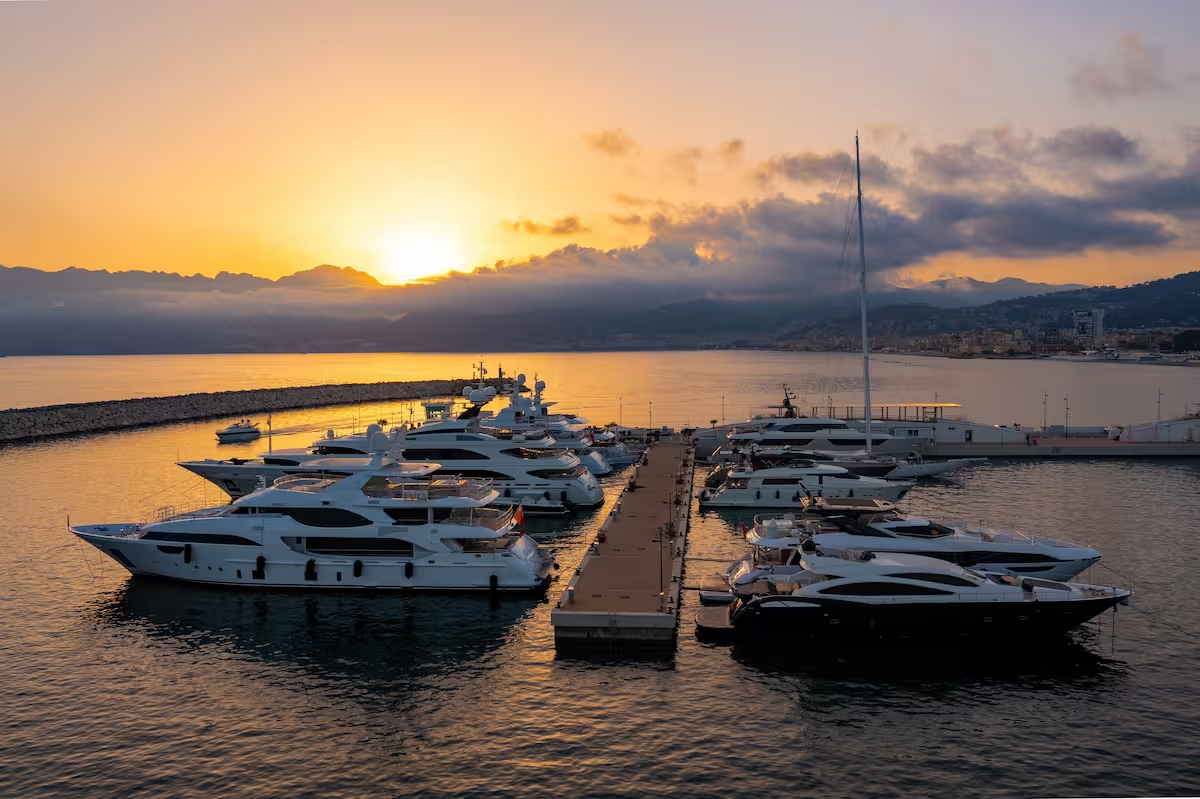
Since then we have grown quite a bit. We have acquired 50 percent of Marina Santa Eulàlia in Ibiza, we won a tender for Marina Botafoc, also in Ibiza. We acquired Port Tarraco in Tarragona and we got a 25 percent stake in Marina d’Arechi in Salerno, Italy. Finally, last year, we won a tender for Marina Port Valencia. So we have been around for a while, we know the industry well and we have been following the trends of the last 25 years.
.avif)
So Ocibar is a family business then? How does this shape your approach to managing individual marinas and the network?
Yes, Ocibar is very much a family business and we try to take advantage of that. We try to be very lean. Any problems that arise should be able to reach top management as fast as possible, if necessary. Decisions can be taken and problems can be addressed quickly.
Every marina of course has its own character, you cannot change this even if you wanted to. Small boats, big boats, locals, tourists, leisure, business, they are all different. But we still have to be lean in our structure and decision-making processes. Part of providing the same standard of service across the network - which everyone rightfully expects - is having the same decision-making processes at all your locations.
That said, I don’t strictly believe in the idea of networks in marinas because especially the large yachts go where they want to go. I don’t think we have the power to move the customer in one direction or another.
However, when we know they are in those places - for example maybe they have been in Tarragona and we know they are going to Italy - we can support them with berthing, logistical issues, disposing garbage and so on. In those situations our network and family business structure starts to be powerful.
We have strong business synergies as well. We have one financial division, one accounting division, one environmental division. This makes for an efficient business and is an advantage of being a larger player.
The push to acquire more marinas and expand networks is very strong. Will Ocibar also look to expand further in the coming years?
We will try to expand but we will not rush into doing it. The market has become very popular in the last few years and there are many new players coming in. We have been able to land some good deals and expand, but we do not need to expand fast. We will only do it when we have the right opportunity and when it makes financial sense.
One thing that is quite special about Ocibar is that we are not owned by a fund, unlike many of the other private equity companies running around! We are not going to be sold in the future and this provides a certain guarantee for tenders and administration. They know who is going to be running the marina for the coming years, which is perhaps not the same with other groups.
We also don’t need to have 100 percent ownership of the marina. We can collaborate with partners. Managing a marina used to be simpler, it was less bureaucratic, there was less paperwork. Nowadays everything is a bit more complicated, there is more administration, authorities ask for more paperwork. So we can see that a marina, which was once a pleasure to have, can become a bit of a burden.
By collaborating with smaller marinas, we can take on some of those burdensome responsibilities and do it better and cheaper. This is our unique angle and this is how we won the tenders for Marina Santa Eulàlia and Marina d’Arechi.
Much of the innovation currently underway in the marina industry is in marina administration and management. What investments is Ocibar planning in this area?
We are currently investing in sales and new accounting software to keep up to date with the latest technological trends. It is important we have an administrative backbone that is up to date and working properly. Being part of a bigger group means we can save on insurance and fuel packages, so there are synergies there too.
We are looking to update our marina management software. In Spain there is one really big player, which is Pandora, and that is the one we use. They are updating their software and we are waiting to see what they can offer. But in the meantime we are looking at international players and investigating other options.
How is Ocibar approaching landside development opportunities across the network? Is the focus on leisure or is your strategy more nuanced?
The topic of waterfront and lifestyle investments to compliment the marina and attract additional footfall is an interesting one. I don’t think you can summarise across the board, however. There are many nuances, it will all depend on what you are doing and where.
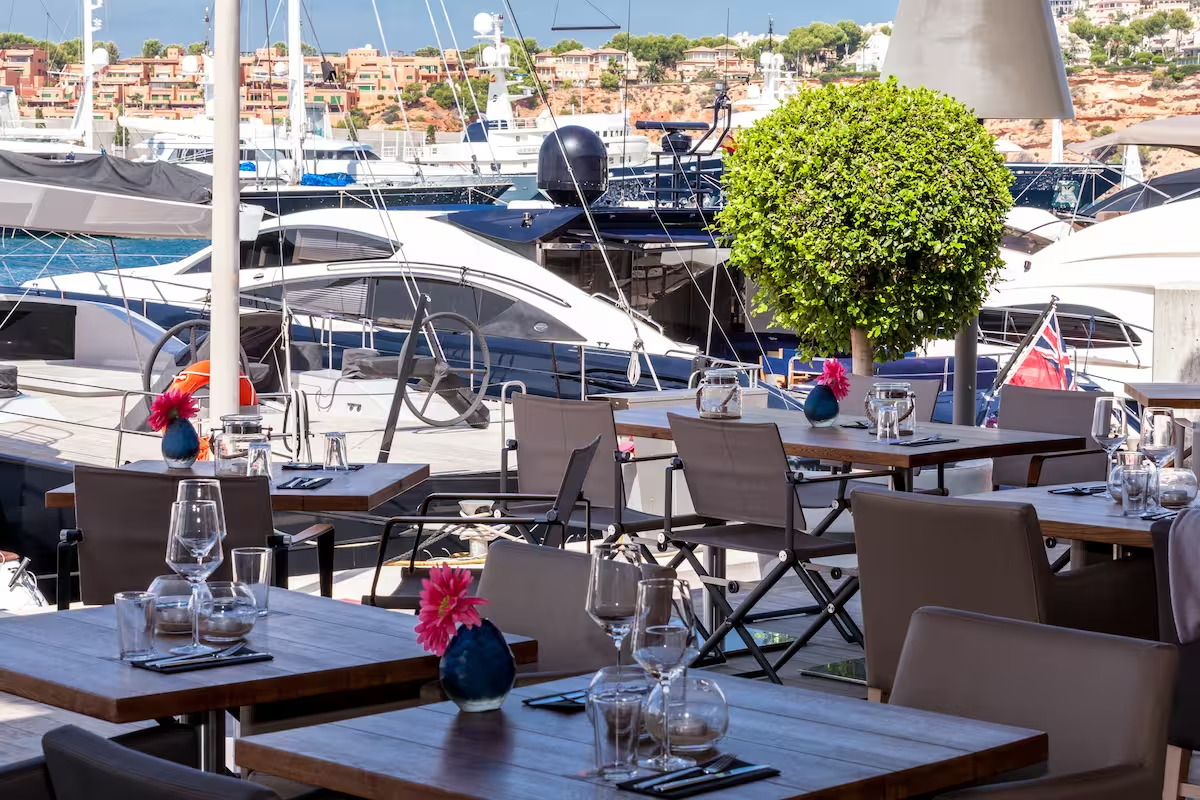
For example, at Marina Botafoc in Ibiza, the marina is right in the middle of the city. It is quite easy to fill it up with restaurants and amenities to create that lively atmosphere. In Port Adriano, Mallorca, we have a mixture of business and leisure, some of which are related to the marine industry, but not all.
But in Tarragona it is completely the opposite. We have some buildings around the marina but it is a business park with offices. It is completely unrelated to the nautical industry. But when you have some elevation above the marina, these areas are a great location to work.
We are taking the same approach in Valencia where there is a lack of office space. There will be some restaurants to provide some life to the marina, but the main focus is offices. With the trend of remote work, companies are increasingly wanting their employees to come into the office. But for this to happen they need to provide a cool atmosphere and working environment.
The city centre of Valencia is very constrained. Down by the marina, however, we can provide office space that is open and bright, overlooking the sea and the boats. You can be minutes away from going paddle-boarding on your lunch break instead of the usual 2pm spinning class that we have in Spain! So we have an interesting angle there. It has worked well in Tarragona and we think it will work well in Valencia too.

.avif)