This article was also published in issue 155 of Marina World magazine. Click here to read the online version.
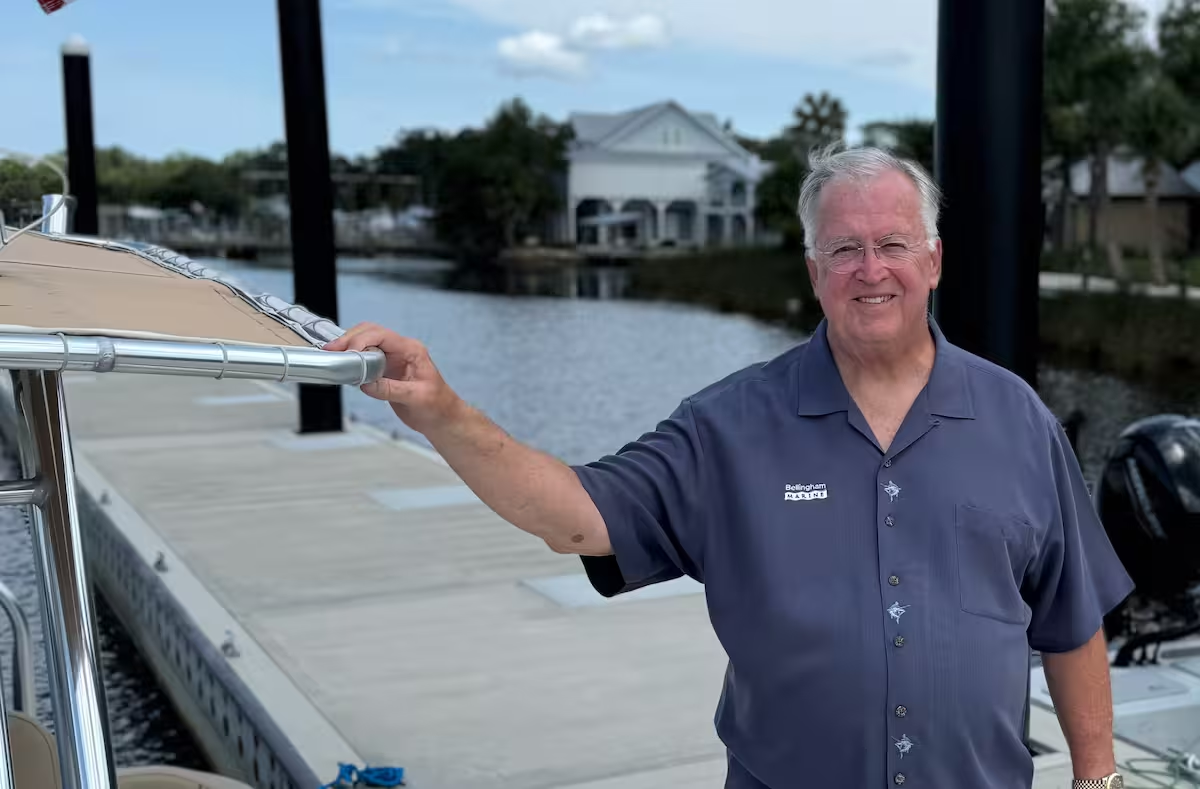
Marina World speaks to a veteran of the North American marina industry, Steve Ryder, who retired in 2026 after working for 38 years at Bellingham Marine.
How did you end up joining Bellingham 38 years ago and what job did you do when you first joined?
I started out working for a mechanical and electrical general contractor located in Kemah, Texas, just south of Clear Lake, which has one of the largest boating populations in the country. The market in that area was growing very quickly and we came in at a pretty good time. I was doing sales, drafting, purchasing and then eventually installation. We built marinas along the Texas Gulf Coast and in Louisiana.
We also happened to be a representative to Bellingham Marine and we got to know pretty much everybody at Bellingham at the time. In 1988 I was called to join Bellingham in their Florida office to expand sales. So I came in as a salesman and I took care of the south Florida and Gulf Coast markets as well as Mexico, Central America and the Caribbean. I pretty much stayed in the same position for the whole 38 years.
How did you manage such a wide portfolio of very large markets? How would you characterise these early years?
The south Florida market is obviously very large and so is the Caribbean, especially from a development standpoint during the 80s, 90s and 2000s. So I gave up the Gulf Coast area to focus solely on these markets, along with Mexico and Central America.
The biggest challenge I faced in growing the market was convincing people that concrete can actually float! When you look at the Caribbean, south Florida and the Gulf Coast, we are in an area that doesn’t have a large tide swing. Normally it’s only around a metre or so. The challenge was to bring the benefits of floating dock systems to the marketplace versus the traditional fixed dock systems.
One of our first projects in south Florida was with the city of Fort Pierce and it showed that concrete dock systems were very good at handling lots of large boats, the necessary utility systems, storm protection and lots of waves. It continued to grow from that.
It was a time of tremendous growth in the marina business, boats were getting bigger, services were lacking because of the general lack of facilities themselves, and the market went through a dramatic change. I was very happy to be a part of it.
How did you navigate and negotiate between all the different factors in these projects? For example customer needs, developer pressures, budget restrictions, climate considerations, and so on?
One of the things that makes Bellingham different is that we are a turnkey general contractor. We take the project from concept through construction. The challenge was to show the benefits that we would give to a developer: you’re not dealing with multiple companies or subcontractors. When people build a condominium project, for example, generally they are looking at a general contractor who is taking care of the construction of the whole facility. We’re one of the very few companies that take it through the concept to turning the key over for the grand opening.
We have also built a good residential market for higher-end type projects. Houses in Naples and elsewhere in south Florida are sometimes spending between $5-50 million on houses, and obviously have boats that go along with them. We have worked on a lot of these properties too and this allowed us to grow with the marine community and establish a network in those areas.
What is your favourite project you have ever worked on, and your favourite project that you never worked on?
That’s a tough question because they are all really unique. The Bahia Mar project was really good because it was done in a very short timeframe for such a large facility. We essentially were contracted about 10 months before the next Fort Lauderdale boat show and we had to have the marina completed for the boat show. It is the number one economic driver for the marine industry in the area. We constantly had worries from local vendors and business about if it was going to be ready in time, but we made it and it was great.
Another project that was fun and also very long term was replacing the docks at the Ocean Reef Club. We started with a couple of the docks but have now rebuilt the entire marina basin and most of the other projects that are out there. Chub Cay in the Bahamas was a lot of fun, but a very challenging one because it is an island. When it was under construction there was not a lot to do other than just work on the docks, but it ended up being a really nice job.
As to your question of which project I wish I had worked on but never did, I will answer it in a different way. Although there are a number of projects we didn’t work on, I was pretty successful in winning those we were involved with. Out of those we didn’t initially work on, in almost every case it turned out to be good that we didn’t get it. There were situations where they did not end up picking the correct product for their needs.
Had we worked on these projects and worked within the developer’s budget, we would have probably had to install systems that would not have lasted our usual 40 or 50 years. There is not really a specific project I could point at, but in many of those cases they eventually came back round after a storm or damage, and we rebuilt it.
To what do you attribute Bellingham’s success in that part of the world?
I think our attention to detail is the defining point between what we offer to the marketplace versus our competitors. That starts with engineering. The marina market in the second half of the 20th century was rather undefined in an engineering sense. It didn’t really take into account wave climates, boat loads, and the transfer of energy and water through the docks and the piles, which is eventually where the forces end up.
We developed a lot of methods to conduct very specific site analyses because every site is unique. There is not an off-the-shelf marina that you can really point at. From the structural requirements, to the utility requirements, wind speeds, wave action, boat loads, access, soil conditions, everything has something different. A lot of these things are pretty common sense today, but in 1989 when I’d ask someone what their soil was like, they would reply along the lines of, “Well, it’s kinda sandy.” We obviously need better information to make a quality dock than just this.
The systems and knowledge we have developed over these decades have meant that well over 90 percent of our projects have survived in very difficult conditions, whether it be water conditions in the northern part of the country or violent weather in the south. These site-specific requirements are still one of the big things we focus on today.
What is the biggest change you have seen in the industry over the last decades? How did you have to adapt to this?
It’s really actually pretty simple. Marinas have become a front-line asset for development. When I first started, marinas were often an afterthought if someone was developing something like a resort with condos and a golf course. It was looked at as being a parking lot for boats.
It’s completely different in today’s market. You can see with the consolidation we have had in the industry - and with the investment this has brought with it - that our industry is now a substantial asset in a development. This has been the biggest change I have seen in the industry.
One thing I think we did very well at Bellingham was to put ourselves in our customers’ shoes. We need to look at a project in the same way an owner would look at theirs, and then run good pro formas to advise them on what they will need to charge to be able to make a good return on investment. Price is not the only determining factor in most cases. If we can show the customer that we understand their business, then, in most cases, we will be successful.
And, finally, now that you have now retired after 38 years at Bellingham, what do you plan to do in your retirement?
Well I’m still going to be part time, working on different projects and helping where I can. I love the company. It’s obviously been something I’ve done for most of my life and it’s a great industry to be in. When I started working for this little contractor in Kemah, Texas, one of the main drivers was that I got to work by the water.
As far as retirement goes, I live in a teeny tiny town in the Big Bend area of Florida called Steinhatchee and we are known for scallops and fishing. These are two things that I also really like doing. So I’ll be having a lot of water time, a little bit of golf time and then some travel too.