This article was also published in issue 153 of Marina World magazine. Click here to read the online version.
Marina World sits down with Toni Mainprize, general manager of South Africa’s Royal Cape Yacht Club, to discuss the club’s community ethos, upcoming investments in its marina and role shaping the future of boating on the continent.
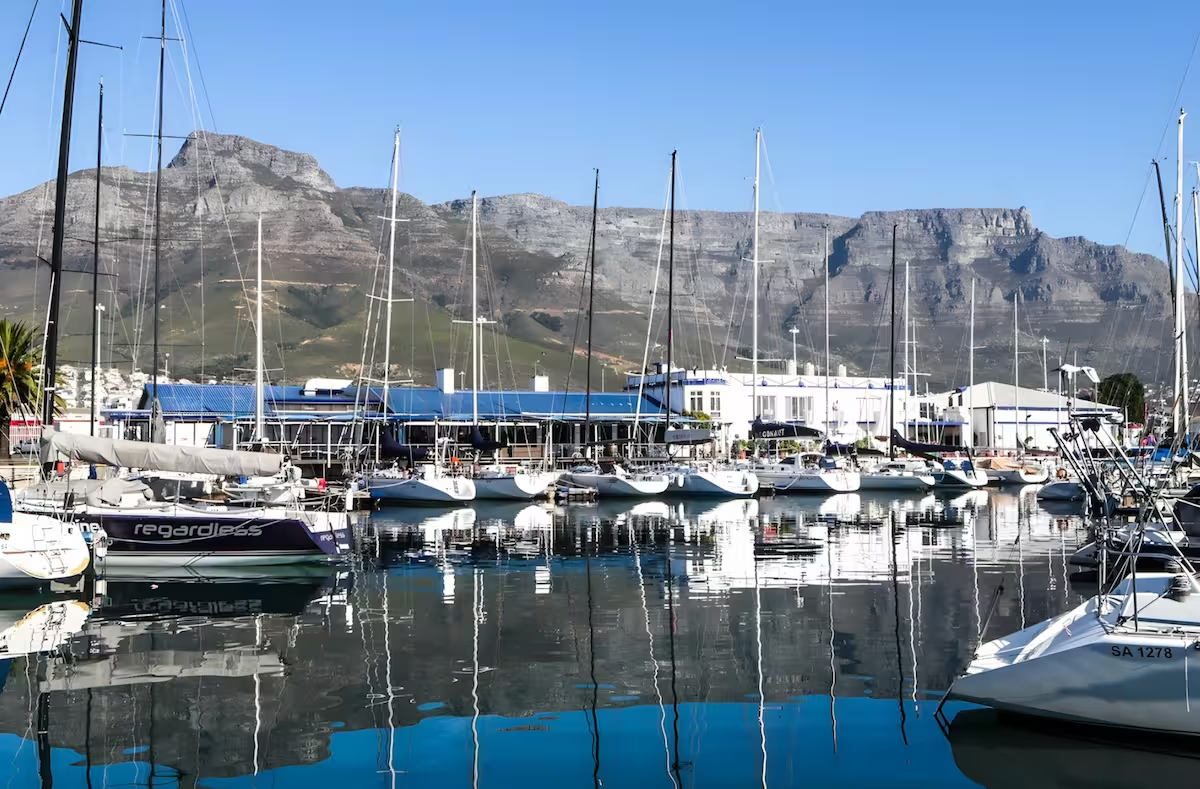
The Royal Cape Yacht Club celebrated its 120th birthday last year. Can you tell me more about the history and evolution of the club from 1905 up to the present day?
We have come a long way since our founding 120 years ago. We started with 22 members and ten boats on 7 April 1905 and have grown to include 1,945 members and 341 registered boats in 2026. I am proud to be part of the legacy of an establishment that has been around for 120 years, especially in a relatively young city like Cape Town. Although the evolution of the club over these years has been huge, the essence of the club has not changed much.
As our president John Levin once said: “It is a vibrant association of diverse individuals whose common denominator is their love for the sea and sailing. Like all human organisations, it is ever-changing and yet, in essence, the Royal Cape Yacht Club is still the same club.”
This is a description that is more apt now than ever before. We still strive to be a place where all members can feel welcome and are proud to be members, and where local and international visitors can feel welcome too. The services we offer are comparable to the best in the world at competitive prices, bearing in mind that any profits generated are for the benefit of all members. But we are also a club that looks beyond the immediate and narrow needs of its members, and we play a role in the larger community of which we are a part.
.avif)
What was your vision for the club when you joined in 2011? How did this evolve when you became general manager?
I joined the Royal Cape Yacht Club in 2011 to improve and expand the sailing events, and to attract more and better sponsors so that we can elevate our offering to members and sponsors alike. This was my initial focus over a five-year period. I was very fortunate to be working alongside a very active and forward-thinking sailing committee led by some great rear commodores of sailing, namely Hylton Hale, Luke Scott and Neil Gregory, all of whom were instrumental in their mentorship of me and the success of my role in the club. In 2017 I was promoted to general manager by then-commodore Vitor Medina, and I have been very fortunate over the past eight years in this role to have had positive, forward-looking leadership. I see this as essential to the survival and growth of yacht clubs.
My role was to effectively manage all operations of the club. We are a relatively large club with five clear departments:
- Food and beverage, with a 160-seater restaurant open seven days a week
- The marina and moorings, which builds, installs and maintains 368 walk-on moorings as well as the yard with an 18-ton crane, 40-ton slipway, cradles, a laundromat, a chandlery and various service suppliers
- The sailing office, which provides racing and cruising events all year round, including the Cape2Rio Race and the Cape to St Helena Race
- Administration, which supports membership, finance, marketing and sponsorship
- The RCYC Sailing Academy, which owns five eight-metre training keel boats to support local communities
My vision was to build a team of five strong heads of each department who are empowered to run these departments as if they were their own businesses. I wanted to ensure they are responsible and accountable for building their teams for the ongoing growth of each department, with the aim of providing a great member experience.
I really feel the value for a general manager of a yacht club is having worked under forward thinking leadership. All my commodores, to whom I report directly, from Vitor, to Neil Gregory, Alan Haefele and now David Garrard, have seen the importance of supporting good management and allowing them to run the club. This has been a substantial change in my years at the club and I believe it is one of the main ways that traditionally committee-managed yacht clubs can be sustainable in the long term.
The next project you will embark on is the marina. What changes and improvements are you looking to make to the marina and how will you go about it?
The marina is an essential service to a yacht club, giving members easy access to their vessels. Having a marina on the doorstep of the clubhouse is a great asset and we hope never to lose this location and accessibility. We are now reaching saturation, with the next challenge being how to persuade the many boats in our fleet that never leave their mooring to make way for boats that are actively sailed. The second challenge is to consider how we can improve our ageing block and chain marinas and to upgrade and create more space.
As our current marinas age rapidly in the increasingly erosive and corrosive environment, they remain a high expense in our annual budget and one that feels like an ever-increasing bottomless pit of money to maintain. It has certainly remained a much-discussed item on the committee agendas over the years, but the sticking point has always been the investment needed versus the security of our tenure in the rented port waters. However, having recently secured our next 20 years, the committee can now look to the global marina industry and investigate upgrading the marina.
Again, under the leadership of forward-thinking committees, the decision to invest a huge amount of club resources into our marina is a brave but necessary one. Marina World is indeed a good starting point and resource to look for solutions and contacts. I look forward to working with our leadership on this exciting yet challenging project.
.avif)
Within your first year of being general manager you founded the Royal Cape Yacht Club Sailing Academy. Why did you decide to found the academy and are there any particular success stories?
When I arrived at the club in 2011 there was no academy and very few young people. There had been various attempts over the years to start a sail training programme for youngsters but a Royal Cape Yacht Club academy had not yet materialised.
I had two teenagers at the time who had started to enjoy Hobie Cat sailing and were ready and eager to try keel boat sailing. The new commodore at the time, Dale Kushner, knew we needed to broaden the base of sailing in the country and devised a sailing programme to enrol young adults and qualified instructors to the club at weekends to learn to sail. “Our focus was on development and upliftment. It was never going to be just about sailing,” he told me.
As I was sailing manager at the time, I set up the academy and I ran it. Later, under the guidance of our president, John Levin, we set up the academy as its own non-profit company - with no members - under the directorship of the Royal Cape Yacht Club. I employed an academy manager so it could be managed as its own entity and become self-sufficient through funding.
The academy has grown from strength to strength. The uniqueness of this academy, which is so different from other yacht club academies, is that we use sailing as a platform to teach life skills to generally under-privileged young adults. We offer the club as an opportunity to integrate and connect these youngsters with the sailing world as a way to access the job market, internships or simply the ocean. We need to ensure that the Royal Cape Yacht Club, as an integral part of Cape Town, provides access to the ocean and to our sport. Without this, the club would not be fulfilling its moral objective of being part of South Africa’s progression to diversity and inclusion.
The Royal Cape Yacht Club regularly hosts events, races and regattas, including the iconic Cape2Rio race. How have these events shaped the identity of the yacht club? What advice would you give to other marinas and yacht clubs looking to organise their own events?
Events and regattas are part of our DNA, they are expressions of who we are as a club. Events like the iconic Cape2Rio Race connect us to the broader sailing world and reinforce our role as a custodian of maritime tradition in South Africa. They also raise standards and that discipline filters into everything we do.
But perhaps, most importantly, events bring people together, which speaks to my earlier comment of a sense of community. Whether someone is competing offshore, volunteering on the bridge or welcoming crews back into the clubhouse, they become part of something bigger than themselves. That shared experience builds lasting loyalty.
For other marinas and yacht clubs looking to host their own events, my advice would be to start with purpose before scale. Strong race management and safety frameworks, volunteer engagement and hospitality, all of these are important and will help ensure that people keep returning for the experience.
.avif)
Boating in southern Africa finds itself at the beginning of an exciting growth phase. What role do you see for the Royal Cape Yacht Club in growing the boating market in southern Africa over the next decade?
We believe we have a responsibility that extends well beyond our marina. As one of the most established clubs in the country, if not the continent, the Royal Cape Yacht Club has both the platform and the obligation to help grow boating across southern Africa. I see our role as lowering barriers to entry while supporting standards of excellence.
That means investing in youth development and training, strengthening partnerships across the marine industry and creating events that inspire participation. We also need to ensure that our facilities and member experience create a modern and inclusive environment. Our ambition is for the Royal Cape Yacht Club to be both a gateway and benchmark of quality for the future of boating in Africa.