





This article was also published in issue 154 of Marina World magazine. Click here to read the online version.
The remote archipelago of the Falkland Islands might be about to see a small but nevertheless full-service marina constructed in its capital city, serving both local boaters as well as larger yachts venturing to and from Antarctica.
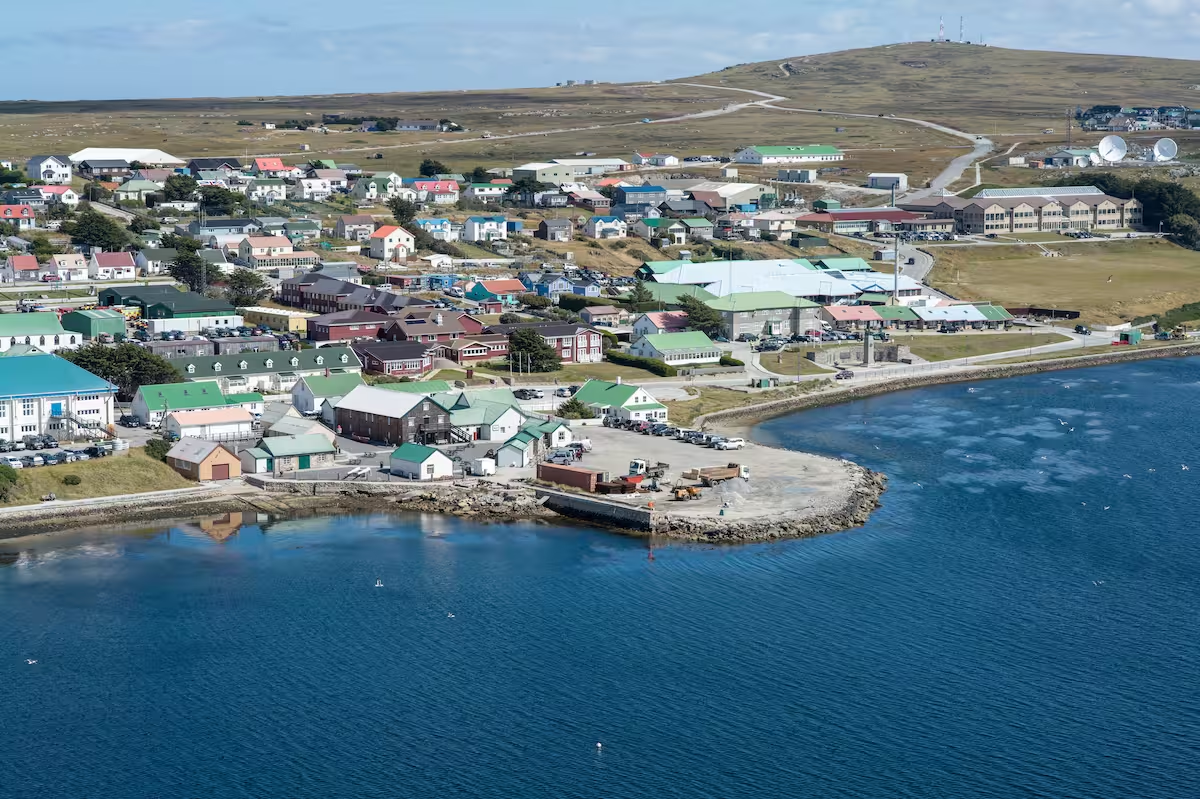
“There have been discussions and ideas around a marina in Stanley for over a decade,” said Zachary Franklin, managing director of the Falkland Islands Development Corporation (FIDC). But, for one reason or another, a full-service marina in this corner of the South Atlantic has never materialised.
About 12 years ago there was a vision to redevelop the entire waterfront in Stanley, which makes up about 80 percent of the total local population of around 3,700 people. An additional 2,000 British military personnel are stationed at the Mount Pleasant Royal Air Force base, but do not represent part of the permanent population.
“Everything from the Falkland Islands Company east jetty all the way up to in front of Government House would have been turned into this whole mixed-use development, including a marina. So the idea of a marina isn’t new,” he said. “It has just never really got off the ground.”
Many pieces of the puzzle for a marina in Stanley are there. There is a yacht club, hobby yachting and some people have even built out their own little jetties in a section of Stanley harbour. Local authorities are currently installing a brand new port facility to aid transatlantic shipping and commercial imports and exports, and people on the island are already aware of a small but notable market for Antarctic tourism. After all, Antarctica is only around 1,200km from the Falkland Islands.
“A couple of years ago, the FIDC rejoined the International Association of Antarctica Tour Operators, or IAATO, where there is also a yacht committee. There is a whole yachting industry that services Antarctic tourism so we know, qualitatively speaking, that there is a certain amount of demand,” said Franklin.
Not only is the demand apparently there, but there is a lack of full-service facilities in the region that can both accommodate larger vessels and provide maintenance. Marinas in nearby Punta Arenas in Chile and Ushuaia in Argentina do exist, but not at the level needed to provide safe and convenient year-round berthing alongside ancillary services.
“Feedback from IAATO and the Falkland Islands Yacht Club has shown that, if given the opportunity to have a marina here, yacht owners and boaters would choose to spend their time in the Falklands over anywhere else,” Franklin told me. “This is the impetus for how we decided to seriously look into building a full-service marina for the Falkland Islands, and in particular Stanley, which has a large, open waterfront but doesn’t have an elegant marina that you might see in pictures like elsewhere around the world.”
Not only do the Falklands know that demand is there, but the hope is that should a marina be built, then more yachts will indeed come. Due to the lack of appropriate infrastructure, arriving vessels currently have to anchor offshore - which is risky given the islands’ harsh and exposed geography - and take a tender in.
.avif)
Enter Haskoning
Preliminary approval for the project was granted after Zachary Franklin and his team presented a vision to the FIDC oversight board, but it was decided that a third party was needed to demonstrate and validate the business case for building a marina in Stanley.
FIDC launched a tender process, about 120 companies around the world accessed the request and 24 put in a full proposal. Arch Henderson, a UK-based company that is part of the larger Haskoning group from the Netherlands, was ultimately chosen to conduct the feasibility study based on their proposals, the timescale and developmental checkpoints.
“It was this that gave our oversight board a better feeling that we could have stops during the development that didn’t commit us to investing fully in things that were unproven before seeing a complete business case,” said Franklin.
“Of course, one of the key steps at the start of the project was going to the Falkland Islands,” said Gosse de Boer, a marine engineer at Haskoning, who visited the proposed site in Stanley in February 2026. “It’s such a unique place that also needs to cater to unique user groups, including Antarctic access and round-the-world sailing,” he told me.
“However, there is limited data and limited yachting at the moment, so we have to put together a financial feasibility study based on local insights combined with our own expertise at Haskoning. We visited the Falklands to hear from the local stakeholders what their view on it was and this is one of the major input factors that we have.”
.avif)
Private investment
That said, a future marina in the Falklands will be far from a Mediterranean-style behemoth. In a first phase proof of concept, the marina might only host as many as 20-25 berths.
“We want to make sure the initial investment and capital expenditure is low,” said de Boer. “For private parties to step in and for the marina to be realised, you have to start small. Generally speaking, we have found that locals in Stanley would welcome a marina, but in their view it should start small and very simple. We should start with safe berthing, because that is the one thing that is missing in the entire Falklands.”
However, the Falkland Islands government does not intend to invest any public money into the project, and so the eventual marina would have to rely solely on private funds. FIDC will therefore be turning to the Falkland islanders themselves - whether it be individuals or local businesses - as well as foreign direct investment to get the project off the ground.
“We will need to design a financing mechanism that is not reliant on public funds,” said Franklin. “There are a considerable number of businesses here, many of which are cash rich but do not have a lot of investment opportunities because not many new projects come along. They also don’t have access to a stock market and the economy in the Falklands is not very complex.”
While there has been some interest from investors in Chile, the FIDC envisions making an offer to the individual and business community in the Falklands based on the feasibility study that Haskoning produces. “The first step would be to create a kind of fund where people could put in money, provided that we can demonstrate the prospect of a long-term return on their investment,” said Franklin. “That way, we will have de-risked an initiative that doesn’t really exist yet and brought some prospect of economic development for the benefit of the local community.”
.avif)
Technical challenges
Building a marina in Stanley harbour would not be without its challenges, says Haskoning’s Gosse de Boer. The site chosen for the marina - called Government Jetty - belongs to the Falkland Islands Museum & National Trust, and while there was some land reclamation to create this area in the first place, it was not built with a particularly solid foundation and neither does it have much bearing capacity.
“If you were to construct larger buildings there you would need to do a lot of ground improvements or even replacing existing materials with something stronger,” said de Boer. “Despite the relative shelter of the harbour, there is still a lot of wind and wave action, so any marina would need some pretty significant breakwater to provide some extra protection. One of the key priorities is safe, year-round berthing and this needs to be properly designed to protect from all wind directions.”
“Furthermore, the water depth is only between two to five metres. To avoid any dredging you would need to limit the yacht draught to that number and only build out the marina as far as you need to accommodate the yachts that you foresee coming,” de Boer continued. “There is also a lot of kelp growth on nearby shorelines and so we are looking at how to avoid impacting that as well. This is not only for environmental benefits but also to reduce any maintenance work afterwards because the kelp can grow back very quickly.”
Haskoning is due to provide their feasibility study on the proposed marina by September 2026, at which point it should be clear whether the project can go ahead. In any case, both Zachary Franklin of the Falkland Islands Development Corporation and Gosse de Boer of Haskoning agree that reducing capital investment and operational expenditure while maximising revenues will be key to securing the marina’s long-term viability.
“If you can keep the balance sheet positive by keeping costs low but revenues high,” said de Boer, “then a marina like the one that is being discussed in Stanley in the Falkland Islands could become a very interesting investment opportunity, especially because there is not much competition in the region.”


.avif)


