This article was also published in issue 154 of Marina World magazine. Click here to read the online version.
Securing the future of the global marina industry will mean changing how the industry sees itself and interacts with all manner of stakeholders, companies and clients, and to what end.
.avif)
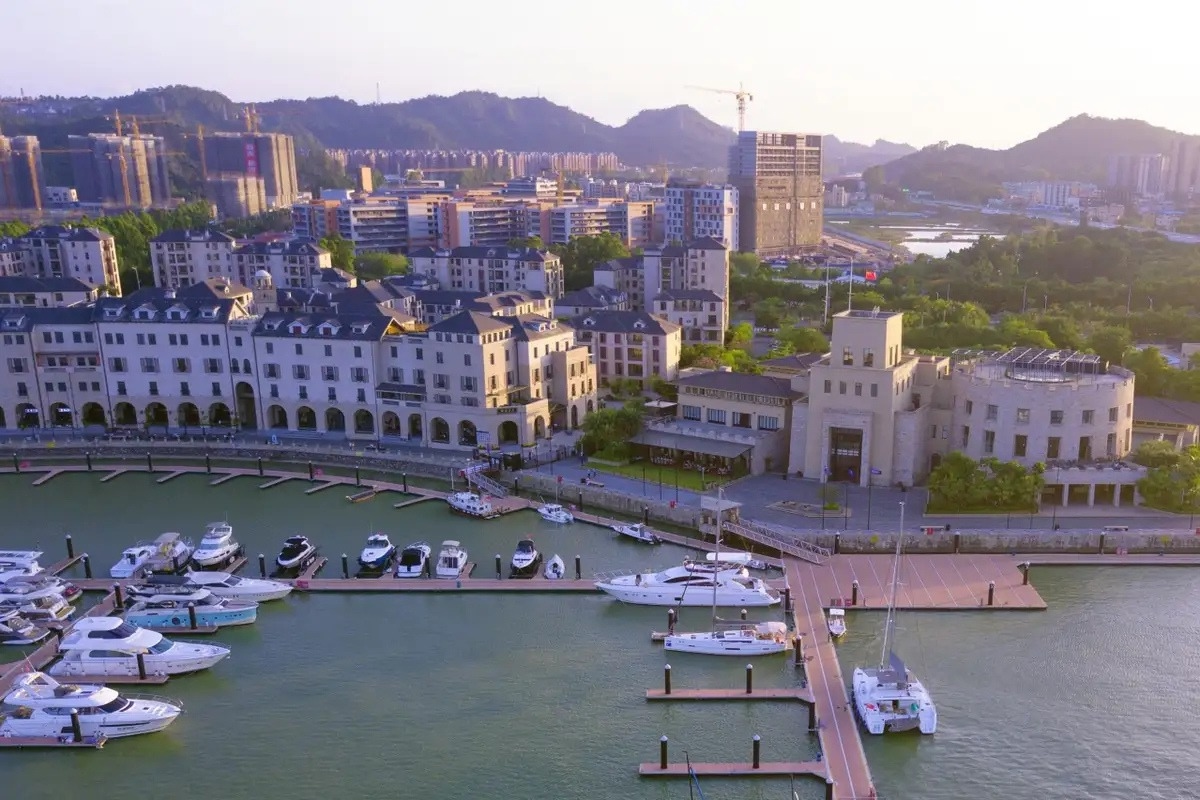
Next year’s ICOMIA World Marinas Conference (IWMC), set to take place in Shanghai, follows an impressive precedent. The 2026 conference, hosted by Vento di Venezia and led by local Olympic sailor Alberto Sonino, celebrated 20 years of regenerating the island of Certosa. Its low-impact marina serves as the financial engine for a serene public park, successfully restoring historical "commons" land through a public-private partnership with the City of Venice.
In the IWMC's commemorative magazine, Sonino’s comments stand out in addressing the social role of marinas. He talks about support for local communities and voices a wish that “future editions will delve further into corporate social responsibility and the role of our sector in promoting sustainable growth, human rights and welfare.”
This is already being put into practice at Certosa, where a social impact assessment by Ca’ Foscari University is currently underway. By tracking indicators like employment and training opportunities, services tailored for families and local citizens, and supply chain integration, this study should offer a valuable reference model for marinas seeking to achieve measurable and positive community impact.
Beyond local community impact, Sonino points out that along popular Mediterranean routes, the luxury yacht sector cannot ignore the visible realities of migrant trafficking and refugee crises. He challenges the industry to look past pure technical prowess and connect high-end transactions with global humanitarian funding.
Mapping the German boating market
This conversation around the broader purpose of a marina coincides with an evolving consumer market. Aiming to future-proof its services amidst a fragmented national registration system, the German Motoring Club (ADAC) recently commissioned a comprehensive market research study.
Emerging data has already revealed a German market far larger than previously assumed with an estimated 3.55 million active boaters aged 16 and over. Although processing is still underway, some of the early insights carry clear implications for infrastructure operators, particularly regarding the notable prevalence of chartering over traditional ownership. Only 12 percent of active German boaters own a vessel, whereas a prominent 51 percent opt for paid charters.
The study also highlights behaviours that challenge traditional marina business models: 67 percent of boaters engage in day or evening trips; just 27 percent sail overnight, while 23 percent choose to sleep ashore in hotels during multi-day holidays. This last contingent highlights a need for specific trailer-boat services, including low-gradient slipways, secure vehicle and trailer parking, dynamic booking and flexible short-term berthing.
The research also exposes a major bottleneck in long-term engagement. While 62 percent of German boaters hold official licenses, there appears to be a sizable gap between earning a certificate and actually taking to the water. As Axel Brinkmann, the senior advisor for pleasure craft and water sports at ADAC, has discovered through conducting training courses, the licensing structure often creates "skippers on paper who have never handled a boat in a crosswind", indicating a not uncommon framework that is heavy on theory but limited in practical experience.
"People invest heavily in these courses, pass the exam and then realise they feel entirely unprepared for the physical realities of the water," he observes. Capitalising on the high interest shown in the ADAC data may require a stronger focus on practical training to build the confidence and competency needed for long-term boating.
.avif)
Seeding marina innovation
Gabbi Richardson, founder of Yachting Ventures, a prominent startup network and growth platform, views the leisure marine industry as being late to embrace the innovation ecosystem that has become commonplace in adjacent sectors.
Yachting Ventures is currently the only organisation focused entirely on startups and scaleups within the leisure marine industry, something Richardson finds surprising:
“When you look at commercial shipping or the wider blue economy, startups benefit from the support of numerous organisations, accelerators and media platforms. In the leisure marine sector, however, that infrastructure is virtually non-existent, despite plenty of innovation happening behind the scenes.”
Yachting Ventures has worked closely with M3 Monaco and the Smart & Sustainable Marina Rendezvous for the past four years, helping to identify and showcase emerging technologies offering solutions for marinas.
- Mediterranean Algae
Beyond natural or engineered flushing systems, marinas have historically limited water quality control to reactive or periodic measures, including visual checks, oil booms or detergents in the event of spills, while better-resourced facilities have moved towards robotic cleaners and macro-waste collectors. Laboratory water testing is expensive and, where not obligatory, rarely conducted with any regular frequency.
Mediterranean Algae, a blue biotech company developing climate infrastructure for marine data intelligence and ecological regeneration, has already deployed its real-time water quality monitoring technology in over 30 marinas across Spain. By continuously tracking a range of parameters including dissolved oxygen, nitrates, phosphates and hydrocarbons, marina operators gain a detailed dashboard overview of ambient water quality, enabling earlier detection and mitigation of environmental risks.
An optional next step is the installation of a smart macroalgae-based bioremediation unit, designed to absorb excess nutrients, filter heavy metals and restore quality parameters in the water column. The system is scaled according to treatment needs, while the resulting biomass is valorised into cosmetics and nutricosmetics ingredients.
As Yago Sierras Peral, Mediterranean Algae’s CEO, explains: “Water quality is no longer just an environmental topic for ports and marinas. It directly impacts reputation, user experience, biodiversity, regulatory exposure and long-term operational resilience.”
- Vela
Through a technical partnership with Meta, AI guest experience platform VELA links a marina’s social media channels to its communication setup, allowing the marina team to handle all incoming customer messages from WhatsApp, Facebook and Instagram via a centralised system.
Combining fifteen years as a sailing instructor with a career in AI solutions in the automotive and real estate sectors, Doğancan Uluğ recalls with frustration how the cost of a night’s berthing for a 12-metre summer berth in popular Med destinations might reach €300 - 500, yet the corresponding on-site support rarely justifies the price. “Even just for topping up my electricity card, I need to walk half a kilometre,” he protests.
By modern tourism standards, paying premium prices for low-quality service is not sustainable. Someone using a yacht service for fewer than twenty days a year, in varied and unfamiliar destinations, expects a similar quality of experience to that of a comfortable hotel. To deliver this, VELA uses AI to answer guest queries on topics about berthing, provisioning or technical support. If the platform cannot answer automatically, it simply alerts the marina.
.avif)
Accelerating innovation in marinas
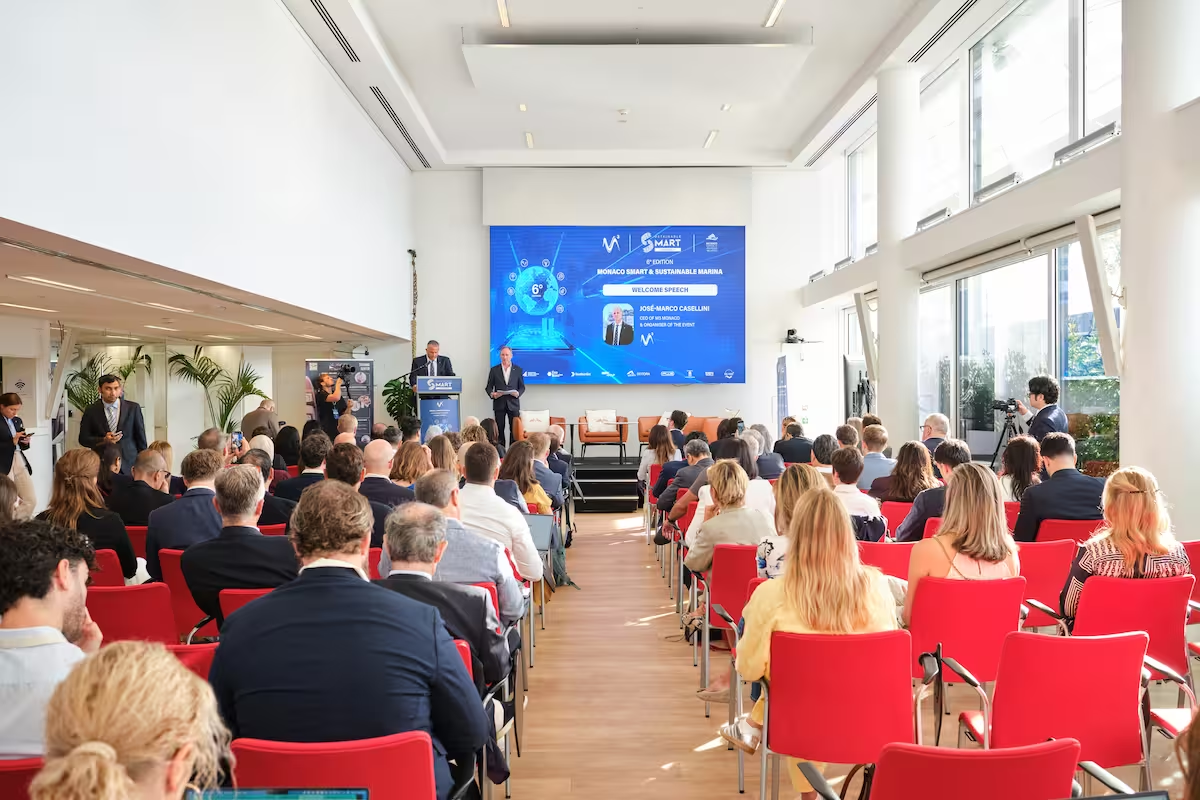
The sixth edition of the Monaco Smart & Sustainable Marina Rendezvous will take place this September. Victor Meyer’s role managing the event often takes him outside the industry to scout for inspiring technologies to introduce to marina managers.
“Marinas globally...tend to use solutions that have already been used somewhere else before or in another marina,” he explains. Accordingly, proposals such as solar-powered desalination, smart-grid infrastructure and robotic water cleaners have been sourced from industries as diverse as agriculture, public works and commercial real estate. He sees marinas as perfect incubators for testing new technologies, given suitable receptivity, minimum disruption and low risk for operators.
The event’s marina architecture competition for 2026 also reflects a notable evolution towards community and public value, with applications obliged to attend to local heritage, contextual sensitivity, wellbeing and recreational functionality.
The challenge of integrating boating into public policy
A significant hurdle for tomorrow's marina network lies in public policy, a challenge well known to Estonian hydrographer Liina Härm.
During nearly 50 years of Soviet occupation, the Estonian coast was a restricted border zone where private boating was strictly controlled, and beaches were monitored by watchtowers and border guards, with sand raked at night to detect fleeing inhabitants. After regaining independence in 1991, Estonia fast-tracked innovation through EU tourism-related support and the country’s famously advanced digital culture to create a modern marina network.
A hydrographer trained in cartography, geoinformatics and small harbour management, Härm’s perspective is based on experience as a surveyor, assessor of port engineering designs, and having managed a group of four harbours. She has also spent years representing Estonia in international recreational boating committees.
Spending long days out surveying amid the unpredictable conditions of Estonia’s coastal waters, Härm particularly values the life opportunities afforded by boating. “This exposure to nature, to life’s fragility, with so much out of your control and yet where you can achieve peace of mind and completely disconnect from your day-to-day concerns, is nothing short of extraordinary. Increasingly, it seems, we live in a society where people have less accountability. At sea, you are presented with the direct consequences of your decisions. Agency is everything.”
She is content to contribute to making waterways safer but decries the lack of coherent management for the country’s marinas, which currently rely on volunteer reporting with no central coordinating body. Marina fleets comprise most foreign visitors, with locally owned vessels representing barely a third.
“I really struggle to convey the potential of recreational boating to decision makers,” she laments. “Here it remains a low priority, predominantly connected to tourism, and, still, dishearteningly, viewed as something for ‘others’.”
Embracing innovation and collaborating with industries outside the traditional marine sphere have long been recognised as fundamental for marina development. Creating a new narrative around boating that celebrates its capacity to deliver wider benefits for human wellbeing, could be both a worthwhile exercise for the boating industry and a practical tool to secure public sector support.