Marinas can do more to create a sense of place by celebrating their maritime heritage for residents and visitors, a simple but often-missed opportunity.

Marinas currently face a number of challenges, amongst them, and especially in the case of privately-owned facilities, establishing relevance within their wider localities. Success in this area includes the potential to attract more people to boating, further positive engagement with local authorities and future business tenants or investors, and extend the talent pool to include a broader and more diverse number of staff applicants. This can be done while also creating more visibility for job opportunities in the marine industry.
Spectacle and service
“People enjoying a walk around a harbour or marina will always be drawn to a historic vessel”, says Camille Gontier, Director of the Fêtes Maritimes in Douarnenez. The Tall Ships Races, which have taken place almost every year since 1956, can draw audiences of hundreds of thousands and have featured fleets of over a hundred vessels often spread across a city’s berthing facilities. Julien Lebas, harbour master of the marina in Le Havre, reported an additional 100 boating visitors during this summer’s event, beyond hosting some of the smaller race vessels. He found that the stopover strengthened their relationship with the local and port authorities, provided businesses in and around the marina with excellent footfall, and added that they benefitted from the resulting media coverage, developing the marina’s positioning as a venue for racing fleets.
The event organiser, Sail Training International, a charitable entity that works with national associations to deliver sail-training opportunities - particularly for disadvantaged youth - ensures that free sailing places are generated through the host city agreement. However, the appeal of the race extends across the board with enthusiastic public responses generating a shared sense of community history, with dramatic photos and news stories helping to boost the attraction of destinations.
Connecting history and opportunity
Charlotte Hathaway took part in the race this year as Master of Excelsior, a traditional 23m Lowestoft fishing smack and the remaining vessel of a once thriving 350-strong fleet. On board, the sailing experience remains as authentic as possible. “While lots of traditional vessels have been modernised slightly to facilitate handling, everything here retains the same dimensions and techniques as in the 1920s such that a fisherman from that era would recognise everything - apart from the liferaft!
“It makes things perhaps a little harder, but essentially this means that we can hopefully sail the boat as well as she can be sailed in accordance with her design. That said, it’s incredible to think that four men and a boy handled this ship, when today we operate the rig with a crew of 17!”
Excelsior, a place marker and source of pride for the local Suffolk community, serves as a valuable resource for demonstrating how to sail a traditional vessel while fostering teamwork, resilience and reliance on others. Other positive outcomes include creating a supportive multigenerational community within the wider port and maintenance facilities, and fostering related job opportunities for young people with challenging personal circumstances.
Hathaway sees the chance to develop skills on board and develop a taste for life at sea as a pathway to future maritime careers, where the decline of the fishing industry has been replaced by offshore wind farms, requiring work boats and crew transfer vessels.
She values the opportunities that the Tall Ships Races offer young people: “For me it’s a perfect event; a massive youth gathering that does everything you want from sail training, from time at sea to international friendships made in port.” Port visits are not always straight-forward, however, with a lack of gangway limiting boarding options. Tying up to a wall requires continual line adjustment but, at 100 tonnes, berthing on a temporary pontoon isn’t an option. Fuelling can also be tricky for such a varied fleet, with some boats taking commercial diesel struggling with high minimal amounts and missing nozzle connections from truck deliveries, and others with depths and pontoon restrictions on fuel docks.
In general, berthing costs and benefits for heritage vessels vary widely, from museum marinas in the Netherlands offering a free heritage berth in exchange for visibility and possible public access, to being charged full whack - plus passenger tax – in other locations. Inevitably, boats return more willingly to destinations that value their visits.
.avif)
Navigating heritage
Celebrating maritime or nautical heritage in marinas can take a wide variety of forms, since shoehorning a Class A square rigger through a narrow entrance into a tight and shallow berth may not always be advisable. Camille Gontier explains that context is important and it can be valuable to understand where and why promoting maritime heritage can be effective.
He highlights two driving elements behind the organisation of maritime festivals: a community motivation from associations and boat owners to preserve and celebrate the local maritime heritage, and interest from local authorities to use these events to address institutional, social and identity-related issues of the host territory.
What works in one country or region may not function as well in another. He notes that in France, with a significant proportion of the population actively participating in boating, the on-board heritage experience in festivals is paramount, which is why in the Fêtes Maritimes in Douarnenez they prize taking paying passengers out for boat trips. He also recognises that whilst summer events may well attract visiting tourists, the greater majority of attendees tends to comprise local or regional residents.
Significantly, the Fêtes mobilise hundreds of volunteers, reinforcing community spirit, providing an opportunity for people to learn traditional skills and creating a deeper appreciation for the locality’s maritime history and culture.
Gontier recounts that in France, from 1983 – 1992, there was a move to reconstruct traditional vessels from original plans or wrecks, with work mostly carried out by associations and supported by regional financing. This replica model differs from many of the known heritage vessels in the Netherlands and the UK where preservation has been favoured. The UK is known for a vast fleet of over a thousand historic vessels, whilst some of the world’s largest heritage vessels are based in the Netherlands. Sail Training International CEO Alan James adds that several South American navies use their tall ships for sail training, which includes a year of learning traditional nautical skills.
Vessel spotlights
Local commercial successes in Brittany include the bisquine replicas La Cancalaise and La Granvillaise, traditional three-masted luggers, formerly dedicated to oyster dredging and trawling. The boats offer sailing trips to the public, participate in festivals and maintain the tradition of the original bisquines.
Within Douarnenez, the Telenn Mor is a famous sardine lugger replica built in 1983 and a notable example of a living heritage vessel. The boat serves as an educational tool, made available to the local sailing school and berthed on the Port-musée pontoons. Over the past 40 years, it's estimated that almost every child in Douarnenez has sailed on the boat via school or club classes. Priority is given to places for females, aiming to give them more sailing opportunities. The Telenn Mor serves as a great example of how a heritage boat can be preserved as a working vessel that contributes to the community and passes on traditional skills to new generations.
The Douarnenez Fêtes Maritimes incorporate a large and popular area dedicated to traditional skills, such as sailmaking, forging, carpentry, canvas work and rope work. These skills are kept alive by associations and taught in schools such as Les Ateliers de l’Enfer, founded in 1979. What is clear is that skills retention will be needed to repair and maintain national fleets, as well as the infrastructure required to take them out of the water, particularly when vessels are limited by financial restraints.
Interactive history
From “Underwater Malta” and Sweden’s “Vrak” museum in the preservation-rich conditions of the Baltic Sea offering virtual tours to shipwrecks in inaccessible dive sites, to the use of TikTok by the National Maritime Museum of Cornwall to drive engagement with sea shanties, innovative approaches are being used to bring maritime history to life.
Solène de Jacquelot, based in Lorient, uses a fully sensorial and physical method to make the learning experience as inclusive and memorable as possible. She encourages visitors to count, collect and weigh imitation sardines using traditional methods, and offers clothing to try on, demonstrating how interior buttons, pockets and blunted clogs were designed to avoid snagging nets.
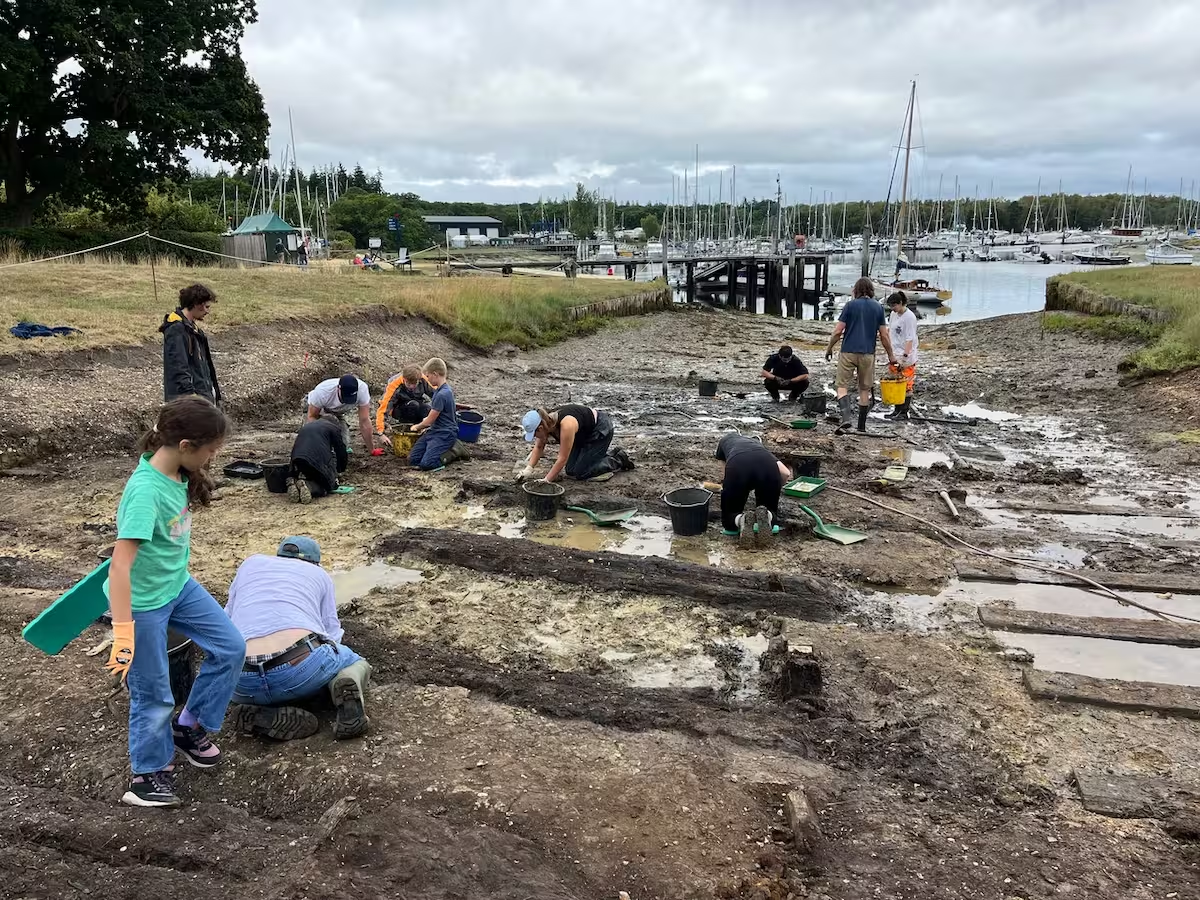
At Buckler's Hard, a perfectly preserved 18th-century shipbuilding village with an award-winning marina, an archaeological dig carried out this summer uncovered a well-preserved 18th-century shipyard slipway. The excavation was conducted by maritime archaeologists and involved the efforts of over 50 volunteers.
The dig revealed a massive timber structure, including large tree trunks that formed the base of the slipway and shed light on how large wooden warships, including Lord Nelson's ship, HMS Agamemnon, were built and launched.
Heritage Harbours
Mary Montagu-Scott, a keen sailor, is Chair of the Buckler's Hard Shipyard Trust and director of the Buckler's Hard Maritime Museum. Between giving talks and lectures and fulfilling various heritage-based commitments, she has an active role in the recently formed Heritage Harbours, a joint initiative between local groups and Maritime Heritage Trust, National Historic Ships and Historic England. One of their aims focuses on making local maritime history a visible and active part of the community's identity.
Wider intentions include trying to counter “sea blindness”, a term that refers to a general lack of awareness or understanding of the importance of the sea or ocean. By making history tangible and accessible through the preservation of historic vessels, maritime museums and community events, Heritage Harbours are looking to connect people not only with their local maritime roots but also with the sea.
At the recent Southampton International Boat Show, the first ever Wooden Boat Stage, organised by Women in Boat Building (WIBB), hosted a constant hub of enthusiasts enjoying the interactive opportunities offered by the stand, together with engaging talks from designers and craftspeople on the past, present and sustainable future of wooden boatbuilding.
.avif)
WIBB founder Belinda Joslin was delighted with the stand's success: "The Wooden Boat Stage was a community collaboration with the Boat Building Academy and the Wooden Boatbuilders Trade Association. The stage showcased a tiny fragment of skills, people and projects, but the show visitors were incredibly engaged. People are passionate about wooden boats and the hands-on skills used - being achievable and relatable - manifesting in an organic, tactile sculpture. Visitors crowded round for carving demos, had a go at riveting and splicing, helped to make rope and were enthralled by steam bending. They then went off and stroked the wooden boats on the stand, with a deeper understanding of the craft that had created them. The skills and stories that are usually hidden away in yards came to life, and the love of the art of boatbuilding was palpable. We’re really proud of what we created and hope to have inspired more people to consider owning a wooden boat.”
Harbours and marinas can leverage maritime heritage to play a key role in transforming their berthing facilities into dynamic cultural assets, firmly integrated within the wider community. From a sustainability perspective, this can be achieved by representing key historical events or insights through exhibitions, art or performance, promoting traditional green cargo projects, facilitating ocean literacy activities on board traditional vessels, supporting community heritage fleets and activities, while also helping to make these opportunities as inclusive and accessible as possible.
Perhaps it is time for a more collaborative international effort to share and develop maritime heritage resources, securing a more sustainable future for marinas and the boating industry.
This article was also published in issue 151 of Marina World magazine. Click here to read the online version.