This article was also published in issue 152 of Marina World magazine. Click here to read the online version.
While inland marinas obviously have a lot in common, they also vary significantly from region to region, with distinct design features that have evolved over time to respond to their environments.
According to the National Marine Manufacturers Association, recreational boating in the United States generates $230.3 billion USD in economic impacts each year through more than 36,000 businesses and over 812,000 jobs. With 11,674,073 boats registered, the United States marina industry touches every part of the country. While the Great Lakes and coastal regions are dominated by larger facilities supporting larger boats able to cruise off shore and from port to port, the interior of the country is home to hundreds of marinas on rivers, lakes and reservoirs.
Northern United States
Marinas in the northern half of the United States are subject to significant seasonal weather variations and generally have a much shorter boating season than southern or coastal marinas that operate year round. In the mountains and northern portions of the United States, the boating season generally begins in mid-April to mid-May and ends sometime in September or October. The heart of the season runs between the Memorial Day and Labor Day holidays, giving these marinas about 100 days of warm boating weather. This drives a higher level of demand across these few weekends, increasing the density of use and density of boats out on the water. Marinas can lose a large portion of their revenue from a few weekends with bad weather, and many marinas diversify their revenue streams with winter storage and off-season services.
The design of marinas in northern climates must consider ice attenuation in addition to wave attenuation, and yearly repairs of ice damage can be very costly. Anchorage design becomes critically important, and marinas either use a flexible system that allows the marina to “ice in”, where the entire floating dock system is locked in ice, and can rise and fall as a unit as water levels change. Another approach uses telescoping spud piles that allow the docks to move up and down on a two-piece pile with a larger diameter outer-pile sleeve that extends below the ice, sliding up and down on a narrower inner pile embedded in the lakebed. The third approach is ice attenuation, using either water circulators or bubbler systems that reduce ice thickness around guide piles, allowing the docks to move freely rather than binding in the ice.
.avif)
Northwestern mountains
Marinas in the mountainous and northwestern regions of the United States are often found on reservoirs and generally share the shorter boating season due to winter conditions. Complicating things further, the reservoirs of the western United States often provide drinking water or flood control, and water levels drop dramatically during winter. In some cases, as in Lucky Peak Marina northeast of Boise, Idaho, lake levels drop as much as 29 metres every winter. The floating dock system uses a traditional winch and cable anchoring system, but supplements the vertical anchoring system with another that pulls the marina horizontally, allowing the marina to float sooner earlier in the season as waters rise, and then pull the entire marina system northward towards the landside amenities as the water reaches summer pool levels. Boat ramps located on reservoirs with this level of water level fluctuation can be 152 metres long or more.
Frisco Bay Marina, located at an elevation of 2,747 metres above sea level in the heart of the Colorado Rocky Mountains, faced a similar challenge, but fortunately was able to “dredge” in the dry winter months using traditional earth moving equipment to create a basin that would allow the marina to be usable without relocation over 90% of boating seasons from May through September, accommodating annual water level changes of three to five metres.
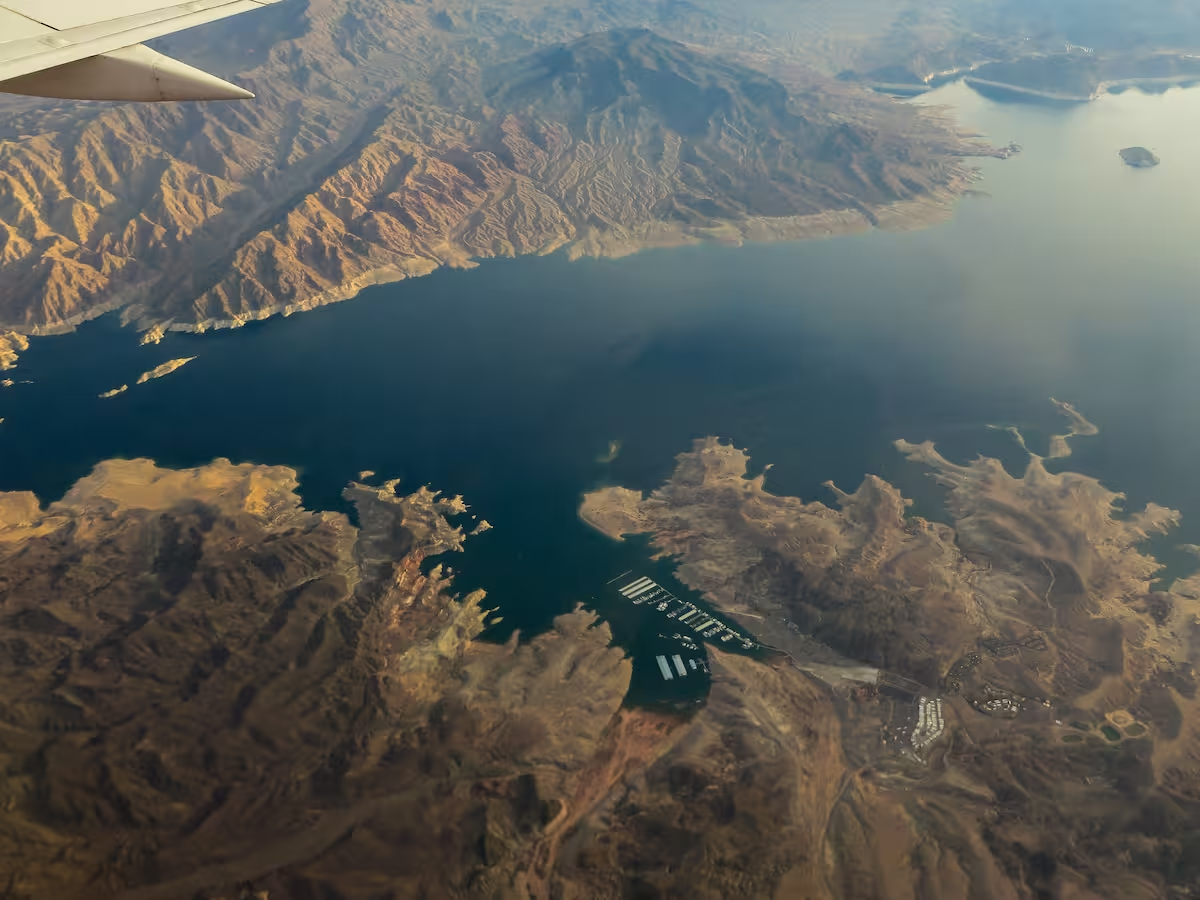
In the western desert regions, truly enormous reservoirs like Lake Powell have faced historic drought conditions, requiring the floating marina facilities to move as much as 800m to maintain navigable water depths.
%20(1).avif)
Southern United States
Marinas in the southern half of the country are characterised by large facilities with covered docks to protect boats and boaters from oppressive heat and the relentless sun. Covered dock systems are nearly always on floating docks, and they create a much cooler and pleasant home away from home for boaters.
One of the oddities of marina design in the United States is the tremendous variation in environmental regulations that change on a state-by-state basis. In Michigan, located in the heart of the Great Lakes, regulators have recently become more strict and may not allow any marina element to be located over the water that is not “water dependent”, meaning that use can only be accommodated over water.
In other words, floating restaurants, restrooms and sometimes even dock boxes are not permitted. New York Harbor has similar restrictions related to coverage, but they focus more on total area and less on specific uses. They set a total area limit and you generally have more freedom in uses allowed within that area. In the Pacific Northwest, they focus more on “light transmission”, meaning how much light can filter through the decking to the water below. In these regions, composite decking with openings that allow light to penetrate are required.
States like Texas and Oklahoma have far fewer restrictions, and in these locations marinas sometimes offer a 15 or 18-metre long covered slip that the boater uses as their summer cottage. They might use half of the slip to store an eight-metre-long wakeboard boat on a lift and then fill in the remaining half of the slip with a floating deck space they transform into an outdoor kitchen with a bar, large screen television and comfortable seating areas. In some cases, they may even lease two adjacent slips and place a floating home in one slip with a smaller boat and outdoor seating next door.
While covered docks offer the ideal marina in hot southern climates, they need to be carefully designed to address wind loads and storm conditions. With our rapidly changing climate, freak snowstorms have sometimes caused major damage to covered dock systems that either did not have a strong enough framing system or sufficient floatation to keep the dock from sinking under heavy snow loads.
Lake of the Ozarks
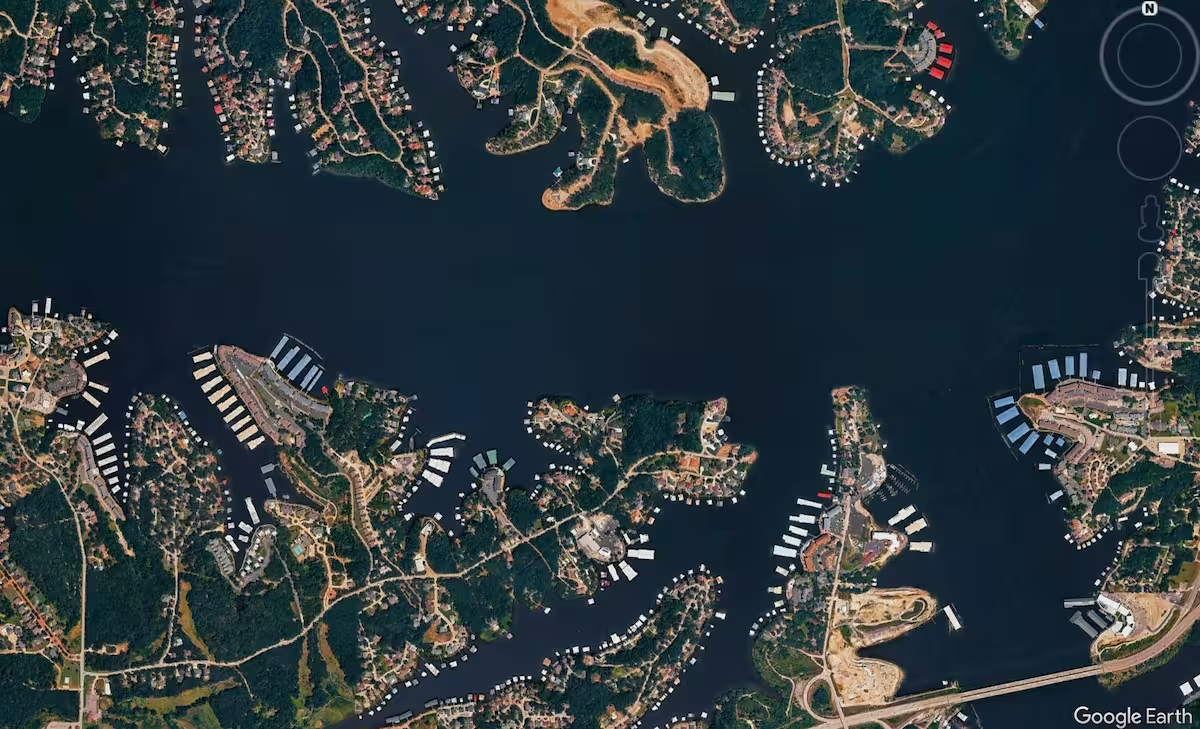
The Lake of the Ozarks is an incredibly popular boating area located in the State of Missouri in the central United States. Boating on Lake of the Ozarks, a very large reservoir with numerous coves and bends, is characterised by covered floating dock marinas seemingly around every corner.
The waterways are narrow and the density of boats is much higher than most any other region in the county. The marina market is very competitive and facilities offer specialised services, bars and restaurants to attract customers.
The Finger Lakes, Riverine Marinas and The Great Loop
The Finger Lakes are a series of large linear lakes in rural upstate New York, some over 48 kilometres long and over 183 metres deep. They are connected by the historic Erie Canal system and are one of the few lake systems in the interior of the United States where a boater can cruise long distances from port to port. These lakes and the canal system that links them form a portion of “The Great Loop”.
The Great Loop is one of America’s great boating journeys. While there are multiple alternate routes, the route is a roughly 9,660-kilometre-long circumnavigation of the eastern United States. Boaters often begin in the northeast in summer, making their way through the St. Lawrence Seaway or Erie Canal, then through the Great Lakes and into the Illinois River through the Chicago canal system. They follow the Illinois River to the Mississippi River and make their way south as winter arrives. They then follow the intracoastal waterway or eastern seaboard until the return to the starting point. Marinas located along this inland passage are often a mix of local boaters that simply enjoy their rivers and “loopers” passing through for a day or two.
Marinas located on the Mississippi River must be able to accommodate dramatic flood waters, requiring floating dock systems with guide piles extending six metres or more above normal water levels, and complex multi-stage gangway systems that meet accessibility regulations.
Summary
Given the wide variety of geographic and climatic conditions, it is no surprise that the United States marina market offers a wide range of marina design strategies to meet the needs of every location. Regional variations in marina design go far beyond the high level overview presented here and the specific design details have significant cost impacts. Of particular interest is how marketing and competition among marinas is also highly regional and how passionate boaters can be.
On the West Coast, for example, most marinas offer single loaded slips, while in the Great Lakes Region double loaded slips are the standard. In the Great Lakes, offering single loaded slips can be a competitive advantage. On the East Coast, fairway widths are often very narrow, sometimes with a ratio as low as 1:1 (boat length to fairway width), compared to the generally accepted standard of 1.5:1 (18 metres fairway for a 12-metre boat slip). In the mountain west, many boaters demand at least 2:1 or 2.5:1, which has huge impacts on density and therefore profitability.
In the end, we can all learn from one another to find what works best for our boaters and visiting marinas around the world is a great learning experience.

.avif)