This article was also published in issue 153 of Marina World magazine. Click here to read the online version.
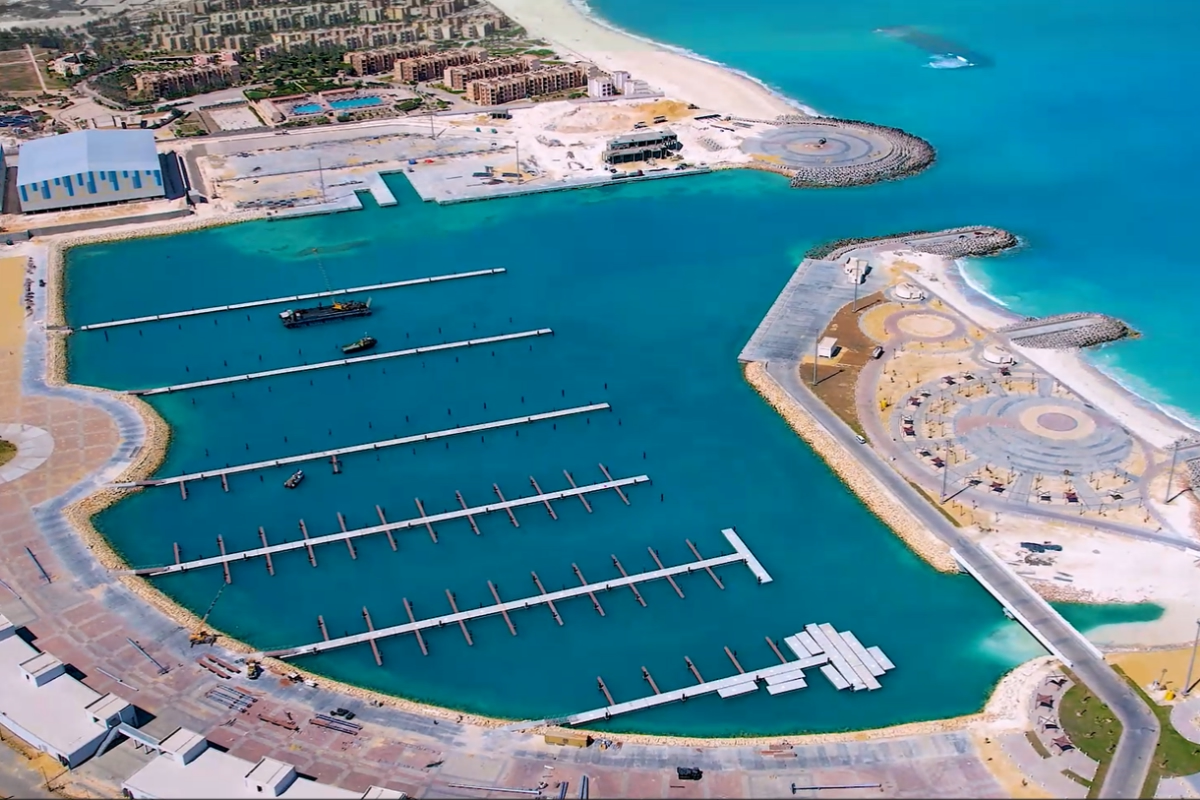
A leading French manufacturer of aluminium pontoons, Poralu Marine, began as a local, almost incidental activity to gradually become a sustainable business with its own brand. Marina World sits down with their group growth director, Christophe Sauné.

Poralu Marine recently celebrated a big milestone. Could you tell us more about the inception and history of the company?
Poralu Marine’s history started around 40 years ago between Lyon and Geneva, in a small village called Port — a rather fitting name for a company whose main business is to build harbours and marinas all over the world.
At the time, the mother company was an industrial group specialising in steel structures for buildings and aluminium joinery. This heritage is a strong marker of who we are today: a company rooted in metallic materials and structural engineering with a strong wish to develop around industrial activities. Our expertise in aluminium, a material that would later become central to our marine solutions, comes directly from these early years.
The marine business itself started quite simply, with a request from a private individual for a small floating dock. That first project led to another, then another and soon after to the construction of an entire marina. What began as a local, almost incidental activity gradually became a sustainable business with its own brand.
Four decades later, Poralu Marine has completed more than 15,000 projects across five continents, including some of the world's most iconic marinas. While the scale of the marina activity has changed dramatically, the spirit that drove that very first floating pontoon remains at the heart of Poralu Marine.
Poralu describes itself as the "world leader in marine-grade aluminium products" with over 15,000 projects completed worldwide. To what would you attribute this success?
Our success is the result of a long-term strategy that was initiated in the early stages of the company. To start with, we made a deliberate choice very early on to look beyond our French domestic market. While we naturally expanded across Europe, we also expanded our reach much further at a time when international development was far less common.
In 1998, we delivered the Woolloomooloo Wharf in Sydney, Australia, with docks manufactured in our factory in France. In 2001, we strengthened our presence in North America through the acquisition of a company and manufacturing facility near Montreal, allowing us to serve both the North and Latin American markets. In 2007, almost 20 years ago, we completed Yinhai International Yacht Club, the first marina in Qingdao, China, where the 2008 sailing competition for the Beijing Olympics took place, when yachting was practically non-existent there.
This proactive international strategy enabled us to spread our presence globally ahead of many local and international competitors, often positioning us as pioneers in what were considered emerging markets in the marina industry at the time.
These diverse experiences and locations have shaped our technical expertise. We had no choice but to propose infrastructure designed according to local conditions and customer expectations. Designing and delivering projects across vastly different environments has forced us to constantly adapt and innovate. We have tested our solutions in extreme Canadian winters, in regions where temperatures approach 50°C in summer, in hurricane-prone areas of the Caribbean and Latin America, and in typhoon-exposed zones in Asia.
These experiences drove our brand and product. Poralu Marine positions itself as a premium brand offering long-lasting installations combined with a unique level of personalisation. With aesthetics also being a strong marker of our solutions, our reputation is centered on durability, reliability and performance. This is still what helps us stand out in the fierce competition of the marina design and construction industry. We aim to honour our reputation as a premium product, which is why we do not compromise on quality.
Even if it seems a bit common to say, our greatest strength lies in our people. You don’t learn through school or degrees in our business. Each and every employee of the company has been trained to our practices, specificities and everything we do is the result of their combined expertise. Poralu Marine is driven by passionate teams whose primary objective is to deliver our promises to clients, and many of them have spent a significant part of their careers with the company.
.avif)
With Poralu already being well-established across Europe, North America, the Caribbean and Asia, how do you intend to grow the business in both traditional and emerging markets?
Building on our longstanding international presence, our growth strategy is both a continuation and an evolution of what has made us successful so far.
We are already firmly established across most global markets, with commercial and operational presence in Asia, the Middle East, Europe, and North and Latin America. This proximity to our clients is essential. It allows us to better understand local dynamics and their impact on our future marina infrastructures, and also to help our customers benefit from best practices and tailored global expertise. In many parts of the world, the nautical sector is still in its early stages of development. By maintaining a continuous local presence with a long-term vision, we are able to support these markets as they mature, trying to stand out from the competition by being better and not cheaper.
In more mature markets, our development is increasingly driven by our ability to support our existing clients throughout the lifecycle of their projects. This is where the broader ecosystem of Wearth Group plays a key role. Through Marina Management & Consulting, we provide consultancy services to optimise marina operations and development strategies. With Rotax Marine, we offer rotomolded accessories for marinas. And through Poralu Marine Services, we deliver marina refurbishment and maintenance services.

You recently announced that the company will be expanding its range of concrete marina solutions. What factors drove the decision to expand into this market?
This development is a natural extension of our diversification strategy to provide more to our existing clients, whether developers, marina operators or public authorities. Aluminium dock manufacturing remains the core of our expertise, and it is often the best choice for floating structures. However, there are cases where concrete solutions are more suitable and our role is not to promote one material at all costs, but to recommend the right technology for the right environment. Concrete has clear advantages in certain applications, particularly when it comes to heavy-duty structures and wave attenuation systems.
Furthermore, the overall marina development market itself is undergoing a strong and notable evolution. The most naturally protected sites have largely already been developed. New projects and extensions are increasingly located in more exposed areas, where environmental conditions and specifically wave actions are more demanding. This exposure is further amplified by the effects of climate change with more frequent and intense storms. The ability to offer robust protection solutions — such as concrete floating breakwaters — has therefore become essential and a natural complement to our aluminium range of floating pontoons.
Poralu says that, as a company and industrial player, you are aware of your impact on the environment. How are you innovating through research and development to become a more environmentally friendly company?
Environmental responsibility is deeply embedded in Poralu Marine's DNA. It has been part of our approach since the very beginning, long before sustainability became a fancy topic in our industry.
One of the recent initiatives I am personally most proud of is the development of our low-carbon HARMONY dock finishing. This project was not driven by regulation or external pressure. There is no law or standard that requires us to take this initiative. Instead, we chose to take responsibility as an industrial player to demonstrate that a different path is possible.
This has been one of the most ambitious projects undertaken by Poralu Marine in recent years. From the early stages of Poralu Marine, we made the decision to work exclusively with 100 percent recyclable material, keeping in mind that one day the overall value chain would be ready to reuse these recycled materials in an integrated circular economy.
Today, while still being 100 percent recyclable and with no impact on our pontoon structural strength, we can offer docks that are up to 80 percent recycled and bio-sourced, with a carbon footprint that is nearly half that of a standard aluminium pontoon. This initiative is in line with Wearth Group values, developing solutions in harmony with our ecosystems, finding the right balance in between performance and environmental responsibility.
With now three types of docks — NAUTIC (our standard dock), HARMONY (low impact dock) and PREMIUM (high end design and low impact dock) — we encourage further project customisation allowing each and every customer to get "their marina".
We consider true innovation to be anticipating future challenges and acting proactively, rather than being forced to react. Looking ahead, we will continue to invest in research and development to further reduce our environmental impact. As an industry, we can no longer afford to treat these issues lightly and we intend to remain at the forefront of this transformation.
.avif)
How do you think Poralu — and indeed the marina industry at large — will look in five, 10 or even 50 years' time?
We see Poralu Marine evolving further as part of a broader ecosystem within Wearth Group, positioning ourselves as a global marina player.
Our ambition is to continue providing fully integrated turnkey solutions across the entire value chain of a marina project, from design and construction to operation and long-term management, complemented by additional products and services.
Beyond Poralu Marine itself, the marina industry is likely to go through a significant transformation. We are already witnessing a consolidation of market players within the marina industry, particularly in mature regions. Projects are becoming increasingly complex, with higher technical, industrial, financial and environmental requirements. Margins are also under pressure and delivery timelines are shrinking as everyone wants more, faster.
Only the most robust and well-structured companies will have the capacity to meet these expectations over the long term. This will naturally lead to a concentration of expertise and an aggregation of capabilities among a smaller number of key players.

.avif)