This article was also published in issue 154 of Marina World magazine. Click here to read the online version.
In this interview with Marina World, Cynthia Rasch, the CEO of Port Denarau in Fiji, reveals how this unique island location has innovated and adapted to become a standout facility in the South Pacific.
Can you tell me more about the history of Port Denarau?
In 1999 a gentleman called Sir Clifford Skeggs from New Zealand came to Fiji and loved the little wharf that used to be here. He thought about investing in Fiji and the business officially began sometime later in 2000. It was owned by the Skeggs family business until early February 2026, when they sold the business entirely. Sir Clifford Skeggs’ grandson, Nigel Skeggs, who was also a superyacht captain, was my predecessor as the CEO of Port Denarau until 2017 and he had the vision to bring superyachts into Fiji.
The business grew from strength to strength thanks to our marketing efforts. More and more superyachts started passing through Fiji and we grew organically. We were publicly listed on the South Pacific Stock Exchange in August 2019, just before the COVID-19 pandemic reached our shores. We now have over 600 shareholders and I am one of them - you’ve got to believe in your product, right? We also have a substantial shareholder in Fijian Holdings, a highly successful investment company that now owns 51 percent of Port Denarau Marina. The remaining shareholders are institutional and individual investors.
How has the marina expanded geographically in terms of pontoons and docks? What are your business plans after the recent expansion and FHL Holdings acquisition?
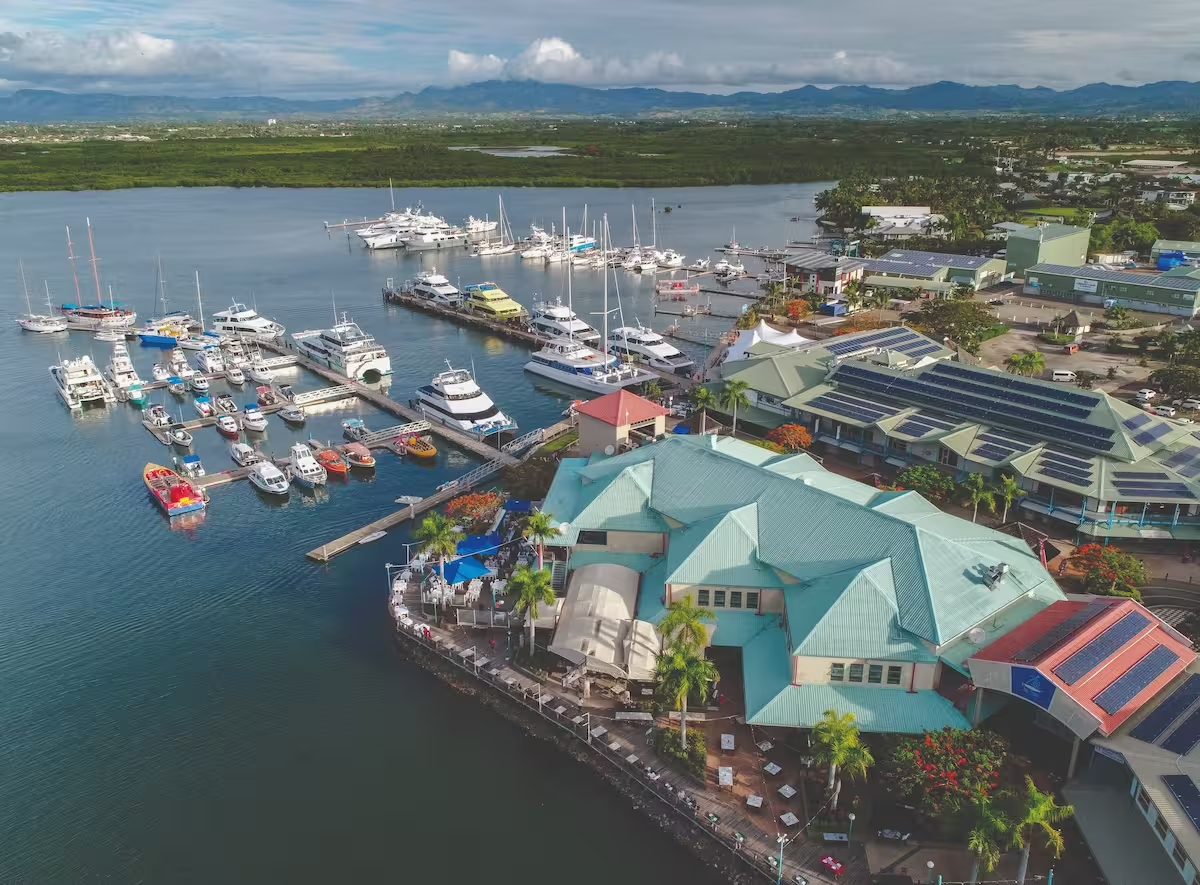
Port Denarau started out as a tiny 24-30m dock for commercial boats and how it has expanded over time is incredible. The marina mostly started growing in 2010 with the first superyacht extension and now the largest berth is 115m. There are 62 berths that are entirely assigned to private vessels.
We are a mixed-use marina, including private vessels, charter operations, commercial ferries, diving operations, local transfer vessels and fishing charters. Transient vessels also stop by during the yachting season, which runs from May to October, and Port Denarau is especially busy during these six months. The cyclone season is quieter and during this period we carry out maintenance, training and development programmes for our team. We also have our land assets, including restaurants, chandleries, workshops and a boatyard with storage and maintenance capabilities, as well as a 30-tonne travelift and reverse forklift.
Given the marina’s current footprint and location, we have the potential for exponential growth. We have developed an expansion-focused masterplan spanning the next two to eight years to make sure we are ready for the Brisbane 2032 Olympics, with further plans to establish various specialised business hubs within the marina precinct.
Around 200 superyachts are forecast to be heading into the southern hemisphere during the Brisbane 2032 Olympics, and I think that there is potential for that number to grow considering the current geopolitical situation. We need to be ready for this influx, hence our motivation to expand further.
There are 62 berths for private vessels and 63 berths for local commercial vessels within the marina precinct. We plan to expand the latter to include over 200 berths, which would then become a hybrid marina consisting of local commercial vessels while keeping a portion of the docks for foreign-flagged vessels and resident vessels living within the marina. We also have plans to reconfigure our private dock, which is currently mainly for charter and superyachts, so it becomes a private luxury facility.
We are currently working on concept planning and design for our land asset expansion and new installations in the marina. We also want to look at different areas of expansion on the waterside, but resources are limited, especially in terms of people, and costs are increasing considerably.
Charter markets have experienced exponential growth over the last few years, with 2024 seeing a minimum 200 percent increase in comparison to 2023, and we are exploring development of our facilities to accommodate more charter vessels. This surge is a direct result of regulatory changes that have made Fiji a more attractive destination for charter vessels, combined with our marketing efforts to promote Fiji as a premier charter destination.
Marketing Fiji on the other side of the globe is the hardest part – it is difficult to make people feel her beauty and understand where it is because it really looks like a speck on the map. But once you are here, you are sold. Fiji sells itself; it is a beautiful location.
.avif)
Where does most of the yacht traffic come from at Port Denarau? Is it mostly Australia and New Zealand or do yachts come from further afield?
We have in fact just done a survey for this with recent up-to-date data. Last year, around 762 smaller vessels visited Fiji, these were mostly cruising yachts under 24 metres. We also welcome between 50-60 superyachts per year. Last year, around 35 percent of these vessels were from Australia, 21 percent were USA-flagged and around 16 percent of the smaller cruising yachts were New Zealand-flagged. But most of the superyachts are from the likes of the Marshall Islands, Turks & Caicos, Grenada and other similar jurisdictions.
We are also located very close to Nadi Airport, which is one of Fiji’s two main international airports. This is one reason why we have become an ideal location. Even for freight and logistics, we sit right in the middle of everything. On a good day, the airport is a 20-minute drive from Port Denarau.
What is best about Port Denarau Marina is that we are located on a fully integrated island, which means that there is no reason to leave the island. You have everything you need at your doorstep, offering a “one stop shop” experience. The island features nine resorts and hotels, spas, shops, several restaurants and bars, complemented by a nine-hole golf course.
Fiji is of course in quite a remote and isolated location. How have you managed your construction projects to overcome the difficulties posed by geography?
Our components and materials are mainly ordered from overseas. For our recent new marina extension, the pontoons were manufactured by Marine Structures in Australia, the piles were sourced directly from China, but all installations were carried out locally and by our own in-house team.
I might joke about it, but it is true when I say that we don’t have “Docks ‘R Us” here in Fiji. We don’t have an outsourced team who turn up with their toolboxes and carry out maintenance at the end of the season. We are a developing and small island nation; we don’t have that luxury.
We prioritise internal development by hiring unskilled teams or we bring construction trainees and give them on the job training. This is a niche market; there are only a handful of marinas in Fiji, local parts and components are scarce and some things have to be imported. Consequently, our team does a lot of custom retrofitting and fabrication to compensate for the lack of off-the-shelf items. This drives innovation in our operations and we’ve managed this challenge quite successfully so far.
A good example of this is our recent 203m dock extension through Marine Structures. They engineered, manufactured and supplied all the pontoons and sent them across in flat racks. Our team and a local piling contractor in Fiji assembled them and managed the extension project.
We are also trying to move away from the old wood timber waler systems because of concerns around maintenance and durability. We now have new pontoons which have aluminium extrusion walers retrofitted into the old infrastructure. Our team together with Marine Structures worked out a technical solution for retrofitting the old with the new, and we did it successfully. It was a great example of leveraging local expertise through international collaboration.
Another great example of how we have innovated and raised standards in Fiji is through our water management solutions. We introduced primary and secondary water filtration systems within our workshop and yard spaces, a technology that no-one has in Fiji. Additionally, we have imported black water pump-out systems and integrated them into our local water supply infrastructure. These were done as part of our voluntary Clean Marina accreditation through Marina Industries Association. Back then, these systems were so advanced that even the local water authority were unfamiliar with them! We take great pride in being trendsetters and we are very fortunate to have dedicated teams that are eager to learn and be innovative.
What are some of the challenges that you encounter on both a daily basis, but also more long term?
Weather is our biggest challenge. We are in a volatile region and have faced Category 5 cyclones that can devastate infrastructure. We are also grappling with rising costs, especially for importing goods and components.
Over the past couple of years, maintaining trade skills has been difficult. The Pacific Labour Mobility schemes in Australia and New Zealand have drawn a significant portion of our skilled workforce away from Fiji. These countries have well-structured programmes with competitive salaries, making it challenging to retain the expertise locally.
Operationally, our berths fill up very quickly. Aside from Savusavu, there are few other marinas in the area, meaning seasonal demands place extra pressure on our facilities. While the goal is to maximise berth utilisation and occupancy, our specific configuration makes this a complex task. But in terms of regulations for charter and superyachts, we have performed exceptionally well compared to our regional neighbours.