This article was also published in issue 154 of Marina World magazine. Click here to read the online version.
Marina World speaks to the general manager of Istanbul’s Ataköy Marina, Artun Ertem, about the growth of the Turkish marina industry, opportunities for cooperation across the eastern Mediterranean and his work as the chairman of his country’s Marine Tourism Association.
.avif)
You have been in the marina industry for a very long time and are a key figure in the Turkish marina industry. Could you summarise your career so far?
I started working in the marina business in 2003 when I became the manager of Club Marina in Göcek, Türkiye. After that I was transferred to Çelebi Marina Antalya to work on a rehabilitation project worth around €7.5 million.
We took over the old marina basin, which was pretty tired and in a generally poor condition, and our company renovated it into the world-class marina it is today with a five gold anchor status from The Yacht Harbour Association as well as many other recognitions.
I was transferred to Croatia in 2009 and afterwards Setur Marinas took over the marina from my former company. I worked at D-Marin’s Mandalina Marina in Šibenik until March 2016, and continued to work in Croatia until 2022, before returning to Türkiye as my son started university here. I have been working at Ataköy Marina since 2023.
How would you say the industry in Türkiye has grown and changed over the last two decades?
There have been incredible improvements in the Turkish marina industry. I am very proud that Turkish marinas are top-notch in terms of superstructure, substructure and in service standards, including those with the five gold anchor status. Standards have been kept very high even in the marinas for yacht owners with lower budgets, and the Ministry of Culture and Tourism, and the Ministry of Transportation and Infrastructure, have really supported this too. Although our berthing capacities are lower than some other European countries, our quality standards are brilliant.
.avif)
How have your years spent working in Croatia influenced your career in Türkiye and the two countries’ respective marinas industries?
I was the first Turkish general manager of a marina in Croatia, from 2009 to 2016. We introduced Turkish standards in constructing and managing marinas, and my personal opinion is that we contributed to improving the service standards and general understanding of the marina industry in Croatia as a whole. Croatians are very good at nautical activities and they have deep-rooted maritime traditions, perhaps even more so than in Türkiye.
Although Croatia is a country of only some four million people, the nautical lifestyle has penetrated into their social fabric. In Türkiye, however, the nautical lifestyle is much more based on luxury, comfort and upper-class service standards.
Croatians are very hard-working people and I have been lucky enough to work with many of them in this industry. I am proud to have worked for many years in such a great country with great people as Croatia and I have learned a lot from them. I have also been witness to many cordial and mutually beneficial relationships between Croatia and Türkiye over the years.
Does that cooperation between Croatia and Türkiye in the marine industry still exist? And in what way?
I think it does, yes. We have established very strong relationships with our Croatian colleagues and friends. Although our two nations may seem like competitors in the market, I think there is more cooperation than competition. There is also a strong cultural and social bridge between Croatian and Turkish societies.
The same goes for Greece. In the maritime industry, as professionals, we have very good and strong relationships with each other, and whatever we can develop together we would consider as a success. I think they would do the same for their side as well.
How do you view the development of new projects elsewhere in the eastern Mediterranean, in places like Egypt? Do you think there are opportunities for cooperation there, or more competition?
It has to be based on cooperation, of course. The eastern Mediterranean is a great location to be developed in terms of marina investments. Egypt and Israel are two countries with strong traditions of maritime tourism. Syria is another country that borders on the Mediterranean and it would be nice to see them develop their coastal areas once their situation improves. The island of Cyprus is another example of where there are some marinas already, but there is room for more.
In any case, development needs to occur on the basis of cooperation. If nautical tourism across this region can be developed, then new destinations will emerge for the benefit of the end users, including superyachts and local economies. It goes without saying that tourism and conflict do not go well together, so we need peace in our regions so we can develop these touristic activities for the benefit of all stakeholders.
Whether it is the Black Sea - where Türkiye also has a long coastline and great potential, but it is currently affected by the Russia-Ukraine war - the Aegean Sea or the eastern Mediterranean Sea, Türkiye will have a great role to play.
You are also the chairman of the Turkish Marine Tourism Association. Could you summarise the work you do both domestically and internationally in supporting the Turkish marine tourism industry?
Domestically, the major issue we work on is trying to shape the laws and regulations of Türkiye to better help our members. When something doesn’t work as well as it should, we gather our board of directors to come up with some suggestions that we can make to the authorities, for example undersecretaries or the general management of some ministries.
Seeing as marinas work across many sectors and government portfolios, we might have to contact the Ministry of Treasury and Finance, Ministry of Environment and Climate Change, Ministry of Transportation and Infrastructure, Ministry of Commerce or the Ministry of Culture and Tourism, depending on the nature of the issue. Some marinas are built and operated under privatisation laws, some marinas are subject to national trust regulations, and some marinas and fishermen’s ports are subject to the ruling laws of the Ministry of Agriculture.
However, putting the different connections to different government ministries to one side, our main focus is of course on developing the Turkish nautical tourism industry. Internationally, we would like to replicate some of our domestic initiatives on an international scale, and we would like to align our activities with those of our international counterparts as much as possible to promote our country in the relevant markets.
We are of course still a small organisation with a limited amount of power to get to the right people, but we always try our best to make the right suggestions and take the appropriate steps to support our members so they can run their businesses as efficiently as possible.
In which areas do you believe there are the most significant technological developments and innovations in marinas?
Frankly speaking, I am somewhat suspicious of artificial intelligence because, at the beginning, it might seem like it is helpful. But we don’t know how it is going to develop in the future and whether it will be the only catalyst for technological innovations in marina developments and investments. I doubt it, personally. I am not against it, but I think it is something to be monitored very carefully. Something can start out as very good but it might not finish up well.
On the other hand, digitalisation of marinas is one of the most helpful and significant technological developments. For instance, some big groups like D-Marin and Setur Marinas are keen on digitalisation. There are many different, very useful mobile apps that make the lives of yacht owners and marina users easier. I think improvements and developments should focus in this direction.
But this digitalisation is sometimes not straightforward. If the substructure of the marina and its operations are outdated, then adapting technology to the marina basin can become problematic. And we know of course that many marinas, especially in Europe, are far from new. Many have a long history and, in that respect, any brand new marinas must be digitally contemporary and user-friendly.
Are there any environmentally-minded innovations or initiatives that have caught your eye recently?
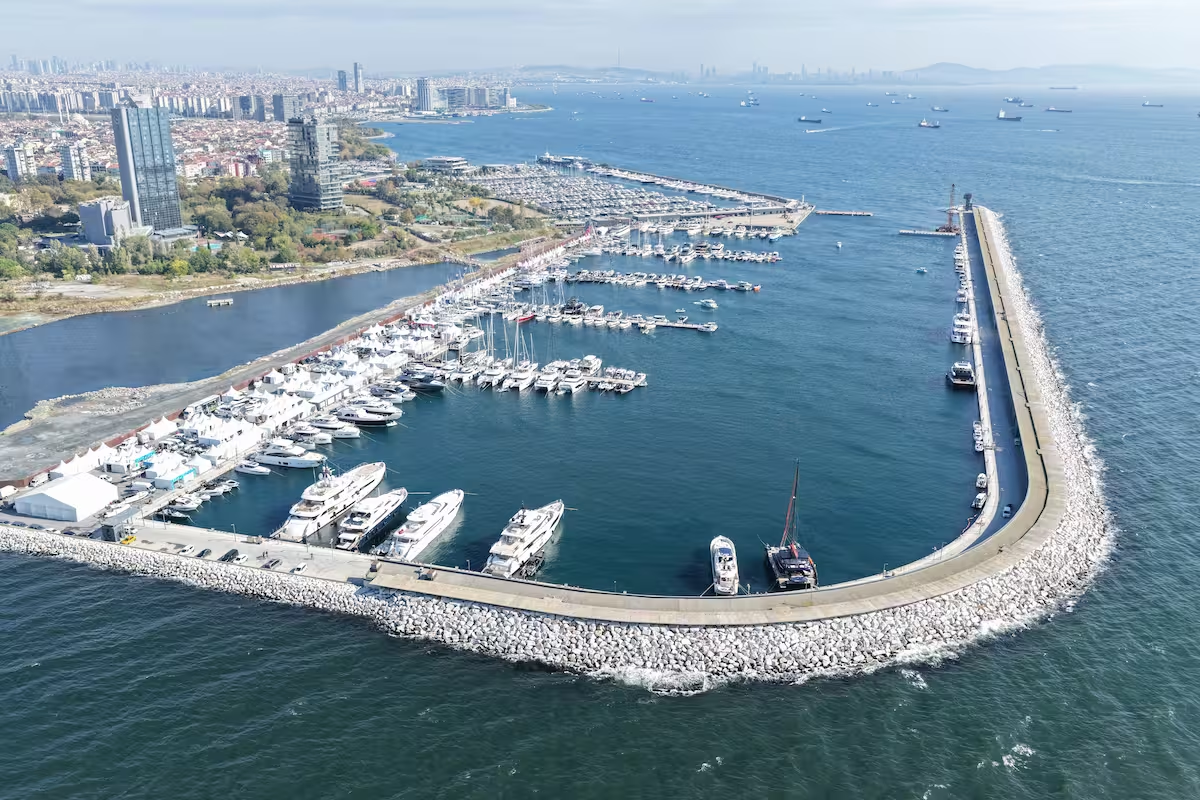
Yes, absolutely, I can give a great example from our Ataköy Marina in Istanbul. We have converted one of our RIB boats from a petrol engine to electric. This is a prototype that we put into service about one and a half months ago, and it has been very successful. We have seen that the costs of this electric solution will be much lower than the old boat with a petrol outboard engine. Not only are maintenance costs lower but it also protects the environment better. Petrol outboards can cause oil spills, so using an electric motor prevents this. We may also convert other service dinghies to electric power if the results continue to be good.
As far as electric charging facilities are concerned, I think it is still a bit early. However, as a superyacht marina, we already have strong power pedestals of up to 600 amps. When the time comes, I don’t believe it will be too challenging to increase the amount of charging capacity. We recently had a hybrid 50-metre superyacht in our marina for two and a half years, and they had very good charging without any problems on their side.

.avif)