Blue21 has completed a feasibility study at Marie Pampoen, Curaçao, examining whether a floating breakwater could contribute to the island’s coastal-protection efforts. Supported by the Partners for Water programme and the Netherlands Enterprise Agency, the study assessed environmental, engineering and economic considerations and recommended a controlled pilot as the next step.
.avif)
Blue21 is a Dutch engineering and consultancy company specialising in floating urban and maritime projects, with work focused on challenges such as rising sea levels, climate change and urbanisation.
At Marie Pampoen, on Curaçao’s southern coast, Blue21 examined the feasibility of a floating breakwater in an area marked by a narrow reef terrace, coral observations, changing wave directions and limited space for conventional coastal protection.
Hydrodynamic modelling, preliminary engineering, environmental studies and economic analysis formed the basis of the study, which also included discussions with government representatives, marine researchers, diving schools, coastal specialists and coral-nursery organisations during two visits to Curaçao.
The company evaluated different floating-breakwater concepts before developing a design specifically for Marie Pampoen. The proposed structure consists of two floating concrete pontoons connected by a submerged steel truss in a catamaran configuration, with an open section between them that allows water to flow through the structure and reduces continuous shading compared with closed floating barriers.
The study found that the floating breakwater could reduce wave energy directly behind the structure. However, modelling also showed that its effect along the shoreline would depend on where it is placed, its orientation, its distance from the coast and how it interacts with the reef system.
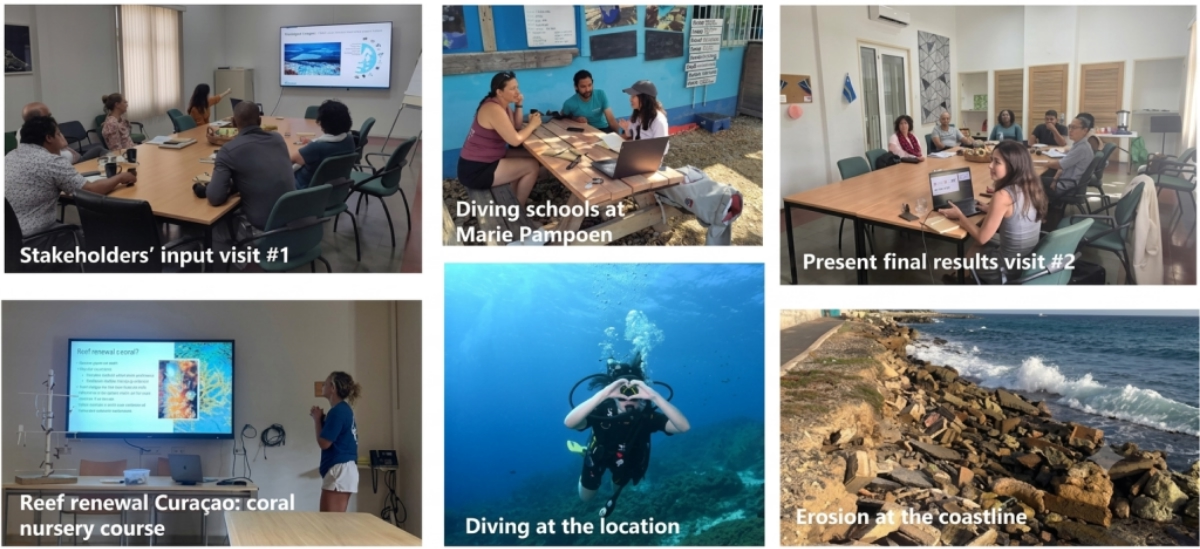
Researchers also found that the submerged steel truss could support coral-nursery or habitat elements in future pilot projects, although further testing would be needed to assess their ecological effects.
Potential concerns related to pile installation, construction activities and long-term shading in coral habitats were also highlighted during the study. In light of those findings, researchers said the environmental suitability of Marie Pampoen remains conditional and suggested that sandy pocket beaches with lower ecological risks should also be assessed for an initial pilot.
Blue21 recommends a controlled pilot covering 30 metres before any larger deployment is considered, as the report concludes that floating breakwaters alone cannot address all of Curaçao’s coastal challenges. It points to shoreline adaptation, infrastructure planning, improved water quality and coral-reef restoration as additional measures that will be needed as the island develops its long-term approach to coastal resilience.
For now, the proposed pilot would provide evidence on where floating breakwaters may be suitable and the conditions required before they can become part of Curaçao’s future coastal-protection strategy.
Images courtesy of Blue21.